


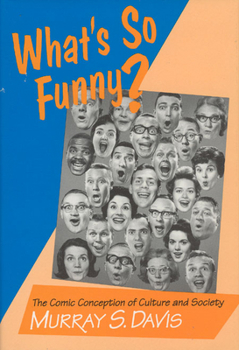
What's so Funny?: The Comic Conception of Culture and Society

Select Format
Select Condition 
Book Overview
Jokes, puns, stories, tales, sketches, and shticks saturate our culture. And today the stuff of comedy is almost inescapable, with all-comedy cable channels and stand-up comics acting as a kind of electronic oracle. We're laughing more often, but what are we laughing at? Murray Davis knows. In this inventive book, he uses jokes (good, bad, offensive, and classic) to reveal the truths that comedians deliver. What's So Funny? is not about the psychology of humor but about the objects of our laughter--the world that comics turn upside down and inside out. It also explores the logic of comedy as a serious, critical assault on just about everything we take for granted. Drawing on a vast array of jokes and the work of dozens of comedians from Jay Leno and Lenny Bruce to Steve Allen and Billy Crystal, Davis reminds us of the extraordinarily subversive power of comedy. When we laugh, we accept the truth of the comic moment: that this is the way life really is. The book is in two parts. In the first, Davis explores the cultural conventions that even simple jokes take apart--the rules of logic, language, rationality, and meaning. In the second, he looks at the social systems that have been at the root of jokes for centuries: authority figures, power relations, and institutions. Whatever their style, comedians use the tools of the trade--ambiguous meanings, missed signals, incongruous characters, unlikely events--to violate our expectations about the world. Setting comedy within a rich intellectual tradition--from Plato to Freud, Hobbes to Kant, in philosophy as well as sociology--Davis makes a convincing case for comedy as a subtle, complex, and articulated theory of culture and society. He reveals the unsuspected ways in which comedy, with its spotlight on the gap between appearance and reality, the ideal and the actual, can be a powerful mode for understanding the world we have made.
Format:Hardcover
Language:English
ISBN:0226138100
ISBN13:9780226138107
Release Date:December 1993
Publisher:University of Chicago Press
Length:400 Pages
Weight:1.40 lbs.
Dimensions:9.3" x 1.0" x 6.3"
Customer Reviews
1 rating
Constitutes an ideal set of humor examples and analysis
Published by Thriftbooks.com User , 26 years ago
I was seeking a book that presented all the various types of humor, categorized nicely, with clear analysis of what made each category of humor work, that is, affect people. I needed to look no further than this book. It is a vast compendium of different types of humor --jokes--and an integrated analysis of what in the human psyche and social situation makes them all work. I used this framework to see humor, its punchline effect, as a non-linear systems dynamic avalanche event, an explosive re-interpretation as contexts clash and are switched among. This book has become a text for me in seminars to managers teaching them how to use humor as a tool to defuse bad situations, exert power without offending self efficacy and images of other people and the like. There is no comparable book in scope, trueness to the data, sensitivity of analysis, and as a basis for serious understanding, research, or training.
Copyright © 2026 Thriftbooks.com
Terms of Use | Privacy Policy | Do Not Sell/Share My Personal Information | Cookie Policy | Cookie Preferences | Accessibility Statement
ThriftBooks ® and the ThriftBooks ® logo are registered trademarks of Thrift Books Global, LLC
ThriftBooks ® and the ThriftBooks ® logo are registered trademarks of Thrift Books Global, LLC
