


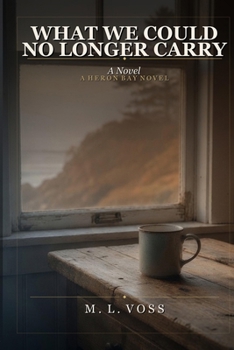
What We Could No Longer Carry

Lena arrives in Heron Bay the way people arrive in small coastal towns when they have run out of other options - quietly, with as little as possible, telling herself it is temporary.
She takes a job at a used bookstore. She rents a room. She keeps the arrangement light enough that she could leave without cost. This is how she has survived: by making herself easy to move. She has been doing it for years. She is very good at it.
The man who owns the bookstore, Marcus, has built his life on the same principle from the other direction. He arrived in Heron Bay years ago and made it small on purpose - the store, a half-finished boat in the shed behind the house, a life organized so nothing could touch him. He thought he was living simply. He was hiding.
What We Could No Longer Carry is the story of what happens when two people who have spent years managing the distance between themselves and the world discover that distance is no longer working.
This is not a love story about grand gestures. There are no revelations in the rain, no airport scenes, no moment where one of them runs through a crowd to stop the other from leaving. What Lena and Marcus have instead is slower and harder and more real: conversations that go somewhere they didn't plan to go, silences that say more than the words around them, the long and unglamorous work of learning to want something without immediately preparing to lose it.
Lena's work takes her to Portland on a rotating schedule - she is a hospice companion, present with dying people and their families in the final weeks and days of a life. It is work that has always given her a reason to keep something in reserve, to stay practiced at goodbye. It is also work that has made her, without her quite realizing it, more honest than most people allow themselves to be. Marcus builds a boat in his shed the way some people keep a suitcase by the door. They are both, it turns out, very good at leaving. The question the novel asks - the only question, really - is whether two people that fluent in departure can learn to stay.
Told in 143 short chapters and an epilogue, the novel moves in close increments: a conversation on a Tuesday evening, a drive back from a house they almost made an offer on, a Saturday morning in the boat shed when something quietly and permanently shifts. The chapters are brief not because the story is simple but because this is how ordinary life actually accumulates - not in turning points but in moments that only reveal their weight later, when you look back and realize something changed without announcing itself.
The prose is exact and unhurried. M. L. Voss writes the way the best interior fiction has always worked - at the level of what people notice and choose not to say, what they do with their hands when they are trying to figure out what they feel, the specific quality of a silence between two people who are both pretending to be more okay than they are.
What We Could No Longer Carry is for readers who have felt the specific exhaustion of managing their own feelings as a full-time job. For readers who know what it is to want something and immediately begin to protect yourself against not getting it. For readers who have been in a relationship where both people were trying very hard and neither of them said so aloud.
By the epilogue, set one year after the final chapter, both characters have stopped managing. They have a new kitchen in a new house. There is a mug in the sink. She leaves for Portland on a Thursday. He goes out to the shed.
It is enough. The novel earns it.
Customer Reviews
ThriftBooks ® and the ThriftBooks ® logo are registered trademarks of Thrift Books Global, LLC
