


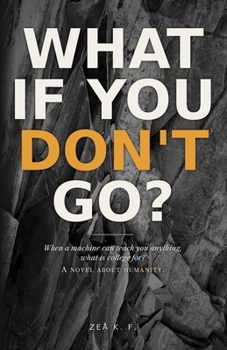
What If You Don't Go?
No Customer Reviews

A machine can teach you climate science in an afternoon. It cannot teach you how to get your neighbor to care.
In the fall of 2026, four eighteen-year-olds make a bet against the most expensive assumption of their lives: that you have to go to college to become someone. Lily trades tuition for an AI tutor that can teach her anything for a fraction of the price. She learns more, and faster, than any undergraduate in the country - and what she learns is that carbon pricing keeps losing at the ballot box for reasons no amount of data will fix. Four years later she is the best-informed person in every room she walks into, and the loneliest. Maya, her twin, goes to Wisconsin anyway, into the messy, inefficient, irreplaceable world of dorm rooms and bad lectures and people who change your mind. She ends up in church basements getting people who disagree with each other to sign on to the same stormwater plan - the one thing her sister, who knows more than she does, cannot do. Jesse never had the money to leave eastern Kentucky. He learns electrical work and climate science from a screen at 2 a.m., and starts putting solar panels on the same ridges the coal companies hollowed out, for neighbors who don't want to be lectured about the weather. Then he writes about it in their language, and people listen. Priya turns her self-education into a following, until the following starts to feel like the only thing she's actually learning. Over four years, the four of them discover everything an artificial intelligence can give them, and everything it can't. Knowledge has never been cheaper or more abundant. The rest - friction, belonging, conviction, the slow work of becoming a person - turns out to be the part no algorithm can hand you. None of them are trying to save the world. They're trying to make one thing work where they are - a roof, a room, a county. Not a solution. A direction. This is a hopeful book, though not a naive one. The damage in it is real and nobody undoes it. But things get built, some of them work, and the people who build them are changed by the building. What If You Don't Go? is a near-future literary novel about education, ambition, and a warming country, told across four lives. It asks the question a generation is now facing for real: when a machine can teach you anything, what is school actually for? Everything is learnable now. The rest is the hard part. In a planned experiment for the times, this book about AI, was written in collaboration with Anthropic's Claude Opus 4.6.Format:Paperback
Language:English
ISBN:B0H795X5K2
ISBN13:9798995697398
Release Date:June 2026
Publisher:Picklemonade Media
Length:340 Pages
Weight:0.78 lbs.
Dimensions:0.8" x 5.5" x 8.5"
Customer Reviews
0 rating
Copyright © 2026 Thriftbooks.com
Terms of Use | Privacy Policy | Do Not Sell/Share My Personal Information | Cookie Policy | Cookie Preferences | Accessibility Statement
ThriftBooks ® and the ThriftBooks ® logo are registered trademarks of Thrift Books Global, LLC
ThriftBooks ® and the ThriftBooks ® logo are registered trademarks of Thrift Books Global, LLC
