


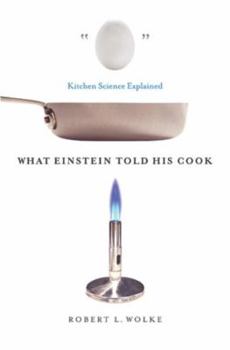
What Einstein Told His Cook: Kitchen Science Explained
(Book #1 in the What Einstein Told His Cook Series)


Select Format
Select Condition 
Book Overview
Do you wish you understood the science of foods, but don't want to plow through dry technical books? What Einstein Told His Cook is like having a scientist at your side to answer your questions in plain, nontechnical terms. Chemistry professor and syndicated Washington Post food columnist Robert L. Wolke provides over 100 reliable and witty explanations, while debunking misconceptions and helping you to see through confusing advertising and labeling. In Sweet Talk you will learn that your taste buds don't behave the way you thought they did, that starch is made of sugar, and that raw sugar isn't raw. Did you know that roads have been paved with molasses? Why do cooked foods turn brown? What do we owe to Christopher Columbus's mother-in-law? In The Salt of the Earth you will learn about the strange salts in your supermarket. Does sea salt really come from the sea? (Don't bet on it.) Why do we salt the water for boiling pasta? And how can you remove excess salt from oversalted soup? (You may be surprised.) In The Fat of the Land you will learn the difference between a fat and a fatty acid, what makes them saturated or unsaturated, and that nonfat cooking sprays are mostly fat. Why don't the amounts of fats on food labels add up? Why does European butter taste better than ours? In Chemicals in the Kitchen you will learn what's in your tap water, how baking powder and baking soda differ, and what MSG does to food. What Japanese taste sensation is sweeping this country? Is your balsamic vinegar fake? Why do potato chips have green edges? In Turf and Surf you will learn why red meat is red, why ground beef may look as if it came from the Old Gray Mare, and how bones contribute to flavor. Want a juicy turkey with smooth gravy? How does one deal with a live clam, oyster, crab, or lobster? In Fire and Ice you will learn how to buy a range and the difference between charcoal and gas for grilling. Did you know that all the alcohol does not boil off when you cook with wine? How about a surprising way to defrost frozen foods? And yes, hot water can freeze before cold water. In Liquid Refreshment you will learn about the acids and caffeine in coffee, and why herb teas are not teas. Does drinking soda contribute to global warming? Why does champagne foam up? Should you sniff the wine cork? How can you find out how much alcohol there is in your drink? In Those Mysterious Microwaves you will learn what microwaves do--and don't do--to your food. What makes a container microwave safe? Why mustn't you put metal in a microwave oven? How can you keep microwave-heated water from blowing up in your face? In Tools and Technology you will learn why nothing sticks to nonstick cookware, and what the pressure-cooker manufacturers don't tell you. What's the latest research on juicing limes? Why are instant read thermometers so slow? Can you cook with magnetism and light? What does irradiation do to our foods?
Format:Hardcover
Language:English
ISBN:0393011836
ISBN13:9780393011838
Release Date:May 2002
Publisher:Norton & Company, Incorporated, W. W.
Length:370 Pages
Weight:1.35 lbs.
Dimensions:1.3" x 5.8" x 8.5"
Customer Reviews
3 ratings
An excellent read, if not entirely comprehensive
Published by Thriftbooks.com User , 21 years ago
Most semi-competent amateur cooks will find this to be an informative and entertaining read. It will likely appeal to fans of Alton Brown's Food TV show "Good Eats". As well as explanations of many foodie things that you will never see explained in run-of-the-mill cookery books, it includes a decent number of fairly straightforward recipes. It is broken into many short sub-chapters, making it easy to read in bursts of 3 or 4 minutes. What it is not, is a comprehensive explanation of all kitchen science. If you are looking for a manual of cookery science and techniques, or a book aimed at budding professional cooks, then look elsewhere.
Kitchen Commentary on Chemistry
Published by Thriftbooks.com User , 23 years ago
This book reads like more like a conversation, or informal lecture than like a textbook or even a cookbook. The author follows a basic cookbook and textbook rule by splitting his subject matter into small and distinct chapters. If you're looking for a cookbook, look elsewhere. This book has some, but they can be found elsewhere. They're used here to expound upon the subject matter of the particular chapter in which they appear. If you're looking for hardcore science look elsewhere, this book is written for the chemistry layman (it includes little techspeak terms most of which you should already know from high school chemistry.) If you're a serious foody you probably already know a great deal of whats in this book. But if you're the average person looking for a good read or a basic food chemistry education this book is perfect. The author dispells many modern food myths, and teaches basic food science.
Allows one to use plastic spoons for caviar, etc.
Published by Thriftbooks.com User , 24 years ago
This is a most delightful book, full of kitchen wisdom and chemistry, good and bad puns, and many, many clever witticisms. It is a flat out pleasure to read, but what really makes it such an outstanding piece of work, and a book every kitchen should have, is that it is so full of information, from why and how corn syrup ends up in sodas to why and how to wash your mushrooms--and yes, they are indeed grown in manure, but not to worry, as Wolke explains on pages 286-288 in a little essay entitled, "You Can't Wash Your Car with a Wet Mushroom." (I believe that.) This is the kind of book you'll find yourself reading from cover to cover instead of peeling the potatoes. Speaking of which, Wolke advises that there is a very slight problem with green potatoes, but that reports of their poisonous nature are greatly exaggerated. (See pages 117-120 for the true scoop.)I have just one problem: nowhere does Wolke say how many sesame seeds are in a teaspoon. However, inspired by Wolke's labor-intensive lime squeezing experiment on pages 281-284, I was able to work it out myself. The answer is 840. I found this by counting the number in a half teaspoon and multiplying by two, genius that I am. (Alas, this was before I realized that I could have counted the number in a quarter teaspoon and multiplied by four.) Which reminds me of the joke about a guy on a train counting cows in a field. When asked how he could do this he explained that he counted their legs and divided by four.Now you may think this was an idle exercise and wonder if I am not slyly making fun of Wolke's book. Au Cointreau! What I learned by counting sesame seeds exemplifies one of the lessons in the book, namely how hard it is to measure anything exactly. On page 294 Wolke asks, "Have you noticed how surface tension makes the liquid bulge up above the rim of the measuring spoon? How accurate can that be?" Well, I have, and I want to tell you getting a straight line of sesame seeds across the top of that measuring spoon was no piece of cake either!There are nine chapters and a really excellent index, suggestions for further reading and a brief glossary. There are some excellent recipes by Wolke's wife, Marlene Parrish. I performed a "thought experiment" on several of them and found that my mouth was watering. One of them, how to make turkey or chicken gravy on page 156 is almost exactly the way I make it. (Smile.) Parrish uses the roasting pan, transferring it to the stove top burners after removing the bird, and then deglazes the pan more or less in the French style. I must note that on the previous page Wolke himself does not recommend this technique finding it "hard to straddle two burners" not to mention "one big cleanup job after dinner."Which makes me wonder who makes the gravy in their household--or, better yet, who does the dishes!The chapters begin with sugar, "Sweet Talk" and end with "Tools and Technology." Wolke gives us a full mouthful on the differences betwee
What Einstein Told His Cook: Kitchen Science Explained Mentions in Our Blog

Blood in Muffins as a Substitute for Eggs?? (And Other Bizarre Kitchen Substitutes)
Published by Beth Clark • October 22, 2018
We chose "Blood and Muffins" as October's theme on account of #Halloween (and because it's #fun), but we had no idea you can use blood IN muffins. As an egg swap. (Gross, we know, but stay with us.) The joke is on us, because it turns out that their protein compositions are so similar they behave almost identically. We're not advocating a return to the old ways when it comes to cooking with blood, but the science nerds in us were curious about this new development, so if yours is too, read on to learn what we discovered about blood (and other strange substitutes).
Copyright © 2026 Thriftbooks.com
Terms of Use | Privacy Policy | Do Not Sell/Share My Personal Information | Cookie Notice | Cookie Preferences | Accessibility Statement
ThriftBooks ® and the ThriftBooks ® logo are registered trademarks of Thrift Books Global, LLC
ThriftBooks ® and the ThriftBooks ® logo are registered trademarks of Thrift Books Global, LLC
