


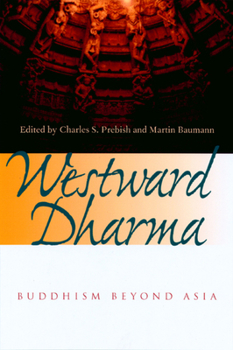
Westward Dharma: Buddhism Beyond Asia

Select Format
Select Condition 
Book Overview
The first authoritative volume on the totality of Buddhism in the West, Westward Dharma establishes a comparative and theoretical perspective for considering the amazing variety of Buddhist traditions, schools, centers, and teachers that have developed outside of Asia. Leading scholars from North America, Europe, South Africa, and Australia explore the plurality and heterogeneity of traditions and practices that are characteristic of Buddhism in the West. This recent, dramatic growth in Western Buddhism is accompanied by an expansion of topics and issues of Buddhist concern. The contributors to this volume treat such topics as the broadening spirit of egalitarianism; the increasing emphasis on the psychological, as opposed to the purely religious, nature of practice; scandals within Buddhist movements; the erosion of the distinction between professional and lay Buddhists; Buddhist settlement in Israel; the history of Buddhism in internment camps; repackaging Zen for the West; and women's dharma in the West. The interconnections of historical and theoretical approaches in the volume make it a rich, multi-layered resource.
Format:Paperback
Language:English
ISBN:0520234901
ISBN13:9780520234901
Release Date:December 2002
Publisher:University of California Press
Length:388 Pages
Weight:1.35 lbs.
Dimensions:1.1" x 6.1" x 9.0"
Related Subjects
Buddhism Modern (16th-21st Centuries) Religion Religion & Spirituality Religious StudiesCustomer Reviews
1 rating
Solid, scholarly overview
Published by Thriftbooks.com User , 16 years ago
Buddhism beyond Asia's explored by 22 scholars in this 2002 collection. It focuses on the transformation, since the later 19c, of the Buddha's teachings into Western, and cross-cultural, and analytical transformations that try to retrieve a purer, primitive, or truer original teaching. Thomas Tweed sums up these evolving trends: "If modernist Buddhists have de-mythologized and rationalized traditional Buddhism one may say that post-modernist Buddhist practitioners secularize and psychologize modernist Buddhism." (60) Tweed distinguishes a "migrant religion trajectory" from a "missionary-driven transmission," in turn separate from a "demand-driven transmission" as the three methods of current transfer. (62-3) He notes how the 'foreign' religion might have deliberately been fetched from abroad by sympathizers and initial converts. In the case of Buddhism, texts in Asian languages were transmitted and published, Buddhist ideas and practices were adopted, and Asian teachers were invited to lecture." (52) Westerners rely on Eastern exchange, as transport, globalization, and immigration thicken the ties rather than allow the crude models of Orientalist domination or imperial manifestation to control the emergence of a dharma-practice adapted not only to secular First World settings, but contemporary capitalist and countercultural markets all over Asia, Brazil, Oceania, and North America. Tweed pioneered efforts to try to define who in this milieu's actually Buddhist. Besides converts, "night-stand" sympathizers who try out practices often in privacy and those who mix and match Buddhist with other religious or therapeutic or esoteric approaches complicate easy tallying. It seems that in Europe, most Buddhists still are of Asian origin, but the authors agree that Westerners continue to make it, as in France, one of the West's fastest-growing denominations. B. Alan Wallace, Martin Baumann, and Charles S. Prebish all discuss the ramifications of this acceleration, as Tibetan Buddhism and vipassana "insight" meditation widen the appeal beyond the slightly earlier arrival of Zen midway through last century. For section two, the territory of Western Buddhism emerges. Baumann looks at Europe, while Richard Hughes Seager examines in America the three strands Tweed separates. Bruce Matthews does the same for Canada, Michelle Spuler for Australia and New Zealand, Michel Clasquin for South Africa, and Frank Usarski for Brazil. In "Buddhism in the Promised Land," Lionel Obadia looks at the tiny Israeli community, comfortable in its Jewish identity while taking on the dharma. A Zen master, Soen Nakagawa, founded an early center with the pun of "Ki"="Basis" and "Butsu"="Buddha" as similar to the Hebrew for "Kibbutz." (181) He also translated poetry based on the linguistic happenstance between "mut"="die" and "Mu"="emptiness" from Japanese. (182) It makes an intriguing counterpart to Rodger Kamenetz' Tibetan-Jewish dialogues documented in "The Jew in the Lotus"
Copyright © 2026 Thriftbooks.com
Terms of Use | Privacy Policy | Do Not Sell/Share My Personal Information | Cookie Notice | Cookie Preferences | Accessibility Statement
ThriftBooks ® and the ThriftBooks ® logo are registered trademarks of Thrift Books Global, LLC
ThriftBooks ® and the ThriftBooks ® logo are registered trademarks of Thrift Books Global, LLC
