


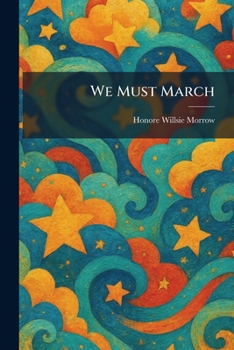
We Must March

Select Format
Select Condition 
Book Overview
"We Must March" is a compelling historical novel that dramatizes the heroic and perilous journey of Marcus and Narcissa Whitman as they help blaze the trail to the Oregon Territory. Set in the 1830s and 1840s, the narrative explores the immense challenges faced by these early pioneers as they cross the rugged Rocky Mountains to establish a mission in the Pacific Northwest.
The story focuses on Narcissa Whitman, one of the first white women to traverse the continent, capturing her resilience and the cultural complexities of life on the frontier. Beyond the physical hardships of the trail, the work delves into the high-stakes political rivalry between the United States and Great Britain for control of the Oregon Country. Through the lens of the Hudson's Bay Company and the American settlers, the book illustrates the strategic importance of the region and the religious conviction that motivated many of its first inhabitants.
Masterfully blending historical detail with vivid storytelling, "We Must March" offers a profound look at the courage, sacrifice, and determination required to settle the American West. It remains a significant literary tribute to the pioneering spirit and the historical figures who shaped the destiny of the Pacific Northwest.
This work has been selected by scholars as being culturally important, and is part of the knowledge base of civilization as we know it. This work was reproduced from the original artifact, and remains as true to the original work as possible. Therefore, you may see the original copyright references, library stamps (as most of these works have been housed in our most important libraries around the world), and other notations in the work.
This work is in the public domain in the United States of America, and possibly other nations. Within the United States, you may freely copy and distribute this work, as no entity (individual or corporate) has a copyright on the body of the work.
As a reproduction of a historical artifact, this work may contain missing or blurred pages, poor pictures, errant marks, etc. Scholars believe, and we concur, that this work is important enough to be preserved, reproduced, and made generally available to the public. We appreciate your support of the preservation process, and thank you for being an important part of keeping this knowledge alive and relevant.
Customer Reviews
ThriftBooks ® and the ThriftBooks ® logo are registered trademarks of Thrift Books Global, LLC
