


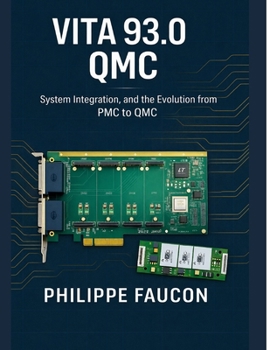
Vita 93.0 Qmc: System Integration, and the Evolution from PMC to QMC

VITA 93.0 QMC is the first book dedicated entirely to the architecture, design philosophy, and real-world system integration of the QMC (Quick Mezzanine Card) standard.
As embedded systems demand higher I/O density, longer lifecycles, and greater configurability, traditional mezzanine formats such as PMC, XMC, FMC, and M.2 are increasingly stretched beyond their original intent. VITA 93 introduces a fundamentally different approach: small, intelligent, management-aware mezzanine modules designed for distributed I/O, connector modularity, and long-term serviceability.
This book explains what makes QMC different-and why it matters.
Rather than treating QMC as "just another form factor," the book dives into the architectural decisions behind the standard:
- IOPIPE-based signal abstraction instead of fixed pin-to-protocol mapping
- PCIe lane flexibility and bifurcation across multiple mezzanine sites
- Mandatory management infrastructure using IPMI and FRU EEPROMs
- Separation of data plane and management plane for safe, scalable systems
- Transition modules (QTM/XIOm/SIOm) that decouple connectors from electronics
- Thermal and mechanical design as first-class interfaces, not afterthoughts
You'll see how QMC enables system designs that would be impractical-or fragile-using Mini-PCIe or M.2, especially in aerospace, defense, industrial control, instrumentation, and long-lifecycle embedded platforms.
The book bridges theory and practice, covering:
QMC fundamentals and connector architecture
Carrier and mezzanine design trade-offs
Power, thermal, and cooling strategies
Firmware, software, and IPMI-based management models
Validation, lifecycle planning, and obsolescence mitigation
Detailed system-level case studies across multiple industries
Clear positioning of QMC relative to PMC, XMC, FMC, and M.2
Written by an engineer for engineers, VITA 93.0 QMC is both a design guide and a systems-thinking reference-intended for hardware architects, FPGA designers, firmware developers, and technical managers who need to understand not just how QMC works, but why it was designed the way it is.
If you are building modular embedded systems that must evolve gracefully over a decade or more, this book will give you the conceptual and practical foundation to do it right.
Customer Reviews
ThriftBooks ® and the ThriftBooks ® logo are registered trademarks of Thrift Books Global, LLC
