


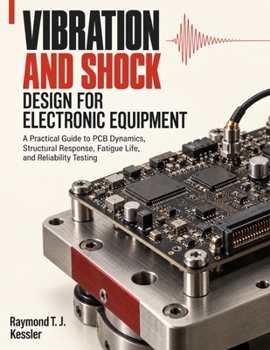
Vibration and Shock Design for Electronic Equipment: A Practical Guide to PCB Dynamics, Structural Response, Fatigue Life, and Reliability Testing

Vibration and Shock Design for Electronic Equipment is a practical engineering reference for understanding, analyzing, and controlling the mechanical environments that affect electronic assemblies, printed circuit boards, components, solder joints, enclosures, and mounting systems.
Written for engineering students, mechanical engineers, electronics packaging engineers, reliability specialists, test engineers, and product designers, this book connects vibration theory with the real mechanical problems found in electronic hardware. It develops the subject from fundamental vibration models through PCB dynamics, fatigue, random vibration, shock response, structural design, qualification testing, and environmental reliability.
The book begins with vibration and shock fundamentals, single degree of freedom systems, damping, resonance, transmissibility, coupled systems, and modal behavior. It then develops beam and plate methods used to predict the response of electronic structures.
Detailed chapters examine printed circuit board natural frequencies, boundary conditions, stiffening methods, ribs, damping, snubbers, wedge clamps, and resonance control. Special attention is given to lead wires, solder joints, interconnects, strain relief, component mounting, cyclic stresses, and vibration fatigue life.
Random vibration receives extensive treatment, including power spectral density, RMS acceleration, frequency slopes, probability concepts, structural random response, fatigue exposure, connector fretting, and response prediction. Separate coverage explains acoustic excitation, microphonic effects, and vibroacoustic response.
Shock design is developed through pulse loading, transient response, drop shock, shock amplification, velocity change, isolation, and shock response spectra. The book then extends these principles to isolators, fasteners, bolted joints, chassis structures, electronic enclosures, manufacturing variation, and mechanical reliability.
The testing chapters address vibration fixtures, shaker systems, accelerometer placement, rocking modes, cross axis motion, fixture resonance, instrumentation, test correlation, qualification planning, and common laboratory problems. The final chapter integrates vibration, shock, thermal cycling, and environmental stress screening into a complete reliability qualification strategy.
Throughout the book, readers will find worked engineering examples, step by step calculations, equations with defined variables, design checks, technical tables, practice problems, summaries, and full color visual guidance.
Topics include:
Vibration and shock fundamentalsNatural frequency and resonanceDamping and transmissibilitySingle and multiple degree of freedom systemsModal analysisBeam and plate vibrationPrinted circuit board dynamicsPCB stiffening and dampingLead wire and solder joint fatigueInterconnect strain reliefSinusoidal vibration testingRandom vibration and PSD analysisRandom vibration fatigueAcoustic excitationShock response spectraIsolation systemsFasteners and bolted jointsElectronic chassis and enclosure dynamicsManufacturing tolerances and reliabilityVibration fixtures and shaker testingEnvironmental stress screeningQualification and reliability planningVibration and Shock Design for Electronic Equipment provides a complete bridge between mechanical vibration theory and the design, analysis, testing, and qualification of reliable electronic hardware.
Customer Reviews
ThriftBooks ® and the ThriftBooks ® logo are registered trademarks of Thrift Books Global, LLC
