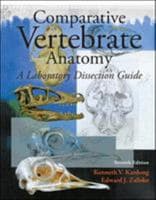
This one-semester text is designed for an upper-level majors course. Vertebrates features a unique emphasis on function and evolution of vertebrates, complete anatomical detail, and excellent pedagogy. Vertebrate groups are organized phylogenetically, and their systems discussed within such a context. Morphology is foremost, but the author has developed and integrated an understanding of function and evolution into the discussion of anatomy of the various systems. This description may be from another edition of this product.
Excellent book to be used in undergraduate and graduate classroons. Helpful in understanding comparative anatomy in detail.
0
★★★★★
Your own history is inside.
By Thriftbooks.com User, March 16, 2006
Your own history is inside, not in simple easy words, so you will have to read, study and you will see how evolution creates so many variations of the vertebrate body plan. Good for teachers and students of general biology, zoology, comparative anatomy and evolution. Darwin would have read this book very happy.
0
★★★★★
I took the Comparative Anatomy class from Kardong.
By Thriftbooks.com User, February 17, 2001
I took the class from which this book was written for. When I took the comparative anatomy class from Kardong he was giving us photocopies from his work in progress and still had editors notes and omissions on the papers. Just from reading all those photocopies, I couldn't wait for this book to come out. I recieved my B.S. in Zoology before this book ever came out and when I recieved my first copy, I was elated. If your serious about zoology, this is a good book for you. However, this book is not for light reading or the beginning zoology student.
0
★★★★★
Vertebrate morphology supreme
By Thriftbooks.com User, November 26, 2000
This university textbook on vertebrate morphology is clearly written and is actually suitable for the general reader with no experience in the subject. Basic concepts such as morphological concepts, phylogeny, paleontology and evolution are discussed at the start of the book. A good overview is presented regarding theories of chordate emergence. Early vertebrates are then presented, starting with a reconstruction of a conodont animal. Chapters on biological design (ie, what adaptations are actually possible) and embryology then follow. Chapters describing and comparing organ systems in various vertebrates then follow, and include the integument (ie, skin), skeletal system, muscular system, respiratory system, circulatory system, digestive system, urogenital system, endocrine system, nervous system and sensory organs.