


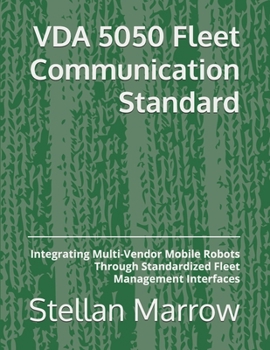
VDA 5050 Fleet Communication Standard: Integrating Multi-Vendor Mobile Robots Through Standardized Fleet Management Interfaces

Build reliable, vendor-neutral mobile robot integrations with confidence. This book explains how a fleet manager, robots, maps, missions, tasks, and status updates fit together in a practical VDA 5050 environment. It is written for engineers, solution architects, integration teams, and operations leaders who need a clear path from theory to working fleet communication.
From first registration to day-to-day orchestration, the guide follows the lifecycle of a mobile robot integration in detail. It covers the interface model, communication flows, data ownership, capability exchange, security basics, and the handling of states, errors, and recovery across multi-vendor fleets.
What you will find insideCore concepts, scope, and terminology, including missions, tasks, identifiers, and state changes.System architecture guidance for centralized and segmented fleet management setups.Transport, connectivity, authentication, authorization, and secure credential handling.Robot onboarding, discovery, metadata validation, and capability normalization across different vendors.Mission lifecycle management, idempotency, correlation IDs, and deterministic state handling.Tasking and navigation instructions, waypoint modeling, coordinate conventions, and execution constraints.API usage patterns for requests, responses, notifications, versioning, and compatibility.Map alignment, localization status, coordinate transforms, and map update handling.Error recovery, operational safety controls, logging, diagnostics, and duplicate prevention.Multi-robot scheduling, conflict control, throughput considerations, testing, observability, and integration validation.Why this book is usefulIt helps translate standard language into implementation decisions.It shows how to normalize vendor-specific capabilities without losing operational meaning.It offers concrete examples for pick-and-deliver, routing, dispatch, and failure recovery.It supports both new integrations and the refinement of existing fleet interfaces.Each chapter combines explanation with a practical example, so readers can move from concepts to design choices and testable behavior. The result is a grounded reference for teams building dependable robot fleet communication across mixed hardware ecosystems.
Customer Reviews
ThriftBooks ® and the ThriftBooks ® logo are registered trademarks of Thrift Books Global, LLC
