


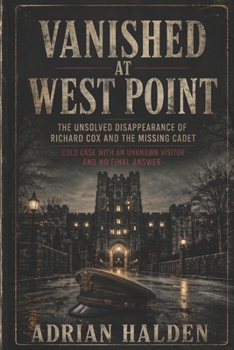
Vanished at West Point: The Unsolved Disappearance of Richard Cox and the Missing Cadet Cold Case With an Unknown Visitor and No Final Answer

In January 1950, a West Point cadet signed out for the evening and never came back.
Richard Colvin Cox was twenty-one years old, a second-year cadet at the United States Military Academy, and a young man whose life had already moved through Mansfield, Ohio, the U.S. Army, and postwar Germany before he entered one of America's most disciplined institutions. On January 14, 1950, he left the academy to meet a visitor whose identity has remained one of the case's most persistent uncertainties. The visitor has long been remembered as "George." The answer to who he was, and what happened after Cox left West Point, never became clear.
Vanished at West Point examines the disappearance of Richard Cox as an unresolved historical cold case, not as a mystery forced into a convenient ending. The book follows the known timeline: the phone calls, the visitor's reported appearances, the final day at the academy, the sign-out, the searches, the institutional response, and the theories that formed around the gaps. It looks carefully at the case for violence, the possibility of voluntary disappearance, the intelligence theories tied to Cox's time in Germany, and the later claims that kept the case alive in public memory.
At the center of the story is a difficult evidentiary problem: no recovered body, no confirmed final destination, no criminal trial, and no public conclusion strong enough to settle what happened. Rather than treating that absence as permission to speculate freely, this account separates documented fact from reported memory, plausible interpretation from proof, and institutional record from public legend.
The book also asks why the Cox case still carries such force. West Point was built on order, discipline, and accountability. A cadet's movement could be recorded, judged, and disciplined. Yet Cox disappeared from within that structure, leaving behind a record that could preserve his departure but not explain the silence that followed.
Written with restraint and attention to the human cost of uncertainty, Vanished at West Point is for readers drawn to historical true crime, missing-person cases, military mysteries, unresolved disappearances, and evidence-aware cold case narratives. It does not promise a solved case. It offers something more careful: a clear, sober reading of what can be known, what remains disputed, and why Richard Cox deserves to be remembered as more than West Point's missing cadet.
Related Subjects
HistoryCustomer Reviews
ThriftBooks ® and the ThriftBooks ® logo are registered trademarks of Thrift Books Global, LLC
