


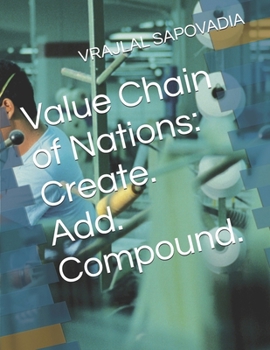
Value Chain of Nations: Create. Add. Compound.
No Customer Reviews

Why do some nations transform limited resources into lasting prosperity while others fail despite abundant wealth?
The Value Chains of Nations: Create. Add. Compound. offers a new way of understanding how nations become prosperous. It argues that wealth is not created by resources alone but through a sequence: creating value, adding value, distributing value equitably, and compounding value across generations. Drawing on economics, management, behavioural science, history, and public policy, the book demonstrates that institutions, leadership, trust, and everyday behaviour determine whether a nation's assets become enduring wealth or wasted opportunity. Natural resources may provide a starting point, but disciplined behaviour and strong institutions decide whether prosperity grows or declines. Through examples from around the world, the book explores why some countries repeatedly innovate, invest, and compound value while others remain trapped in cycles of extraction, corruption, short-term thinking, and institutional decay. It introduces the concept of the Value Chain of Nations, a framework that links individual behaviour, organisational performance, institutional quality, and national development into a single model of long-term prosperity. Written for policymakers, business leaders, academics, students, and thoughtful citizens, this book challenges conventional measures of national success and argues that the greatest asset of any nation is not what it owns, but how its people create, add, share, and compound value over time. This is a book about nation-building-not through ideology, but through the enduring principles that transform effort into prosperity.Format:Paperback
Language:English
ISBN:B0H8CDBN1W
ISBN13:9798186538363
Release Date:July 2026
Publisher:Independently Published
Length:96 Pages
Weight:0.72 lbs.
Dimensions:0.3" x 8.5" x 11.0"
Customer Reviews
0 rating
Copyright © 2026 Thriftbooks.com
Terms of Use | Privacy Policy | Do Not Sell/Share My Personal Information | Cookie Policy | Cookie Preferences | Accessibility Statement
ThriftBooks ® and the ThriftBooks ® logo are registered trademarks of Thrift Books Global, LLC
ThriftBooks ® and the ThriftBooks ® logo are registered trademarks of Thrift Books Global, LLC
