


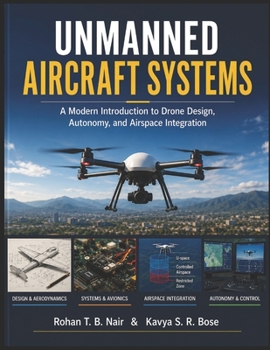
Unmanned Aircraft Systems: A Modern Introduction to Drone Design, Autonomy, and Airspace Integration
No Customer Reviews

An unmanned aircraft is never just the object in the sky. It is a coordinated system of machines, software, and people - and these systems fail not usually because one part is weak, but because the parts were never engineered to work together.
Most readers meet this field in fragments. Aerodynamics sits in one book, autonomy in another, and the regulatory picture in material that is dated by the time it is read. A specialist in one discipline still has to guess how the flight-control system, the data link, or the airspace rules shape the design, and students learn equations without ever seeing how a real vehicle holds together.
This modern, comprehensive introduction treats the whole machine as one integrated subject. It develops the fundamentals of flight from the ground up, then shows how aerodynamics, propulsion, structures, control, autonomy, payloads, data links, and launch and recovery combine into a working system - while giving full weight to the three shifts reshaping the field: airspace integration, machine autonomy, and the contested low-altitude environment.
Inside, you will: See how every major subsystem constrains, and is constrained by, the rest of the aircraft.Work through the physics of flight with clear equations and examples carried through in full units.Estimate range, endurance, climb, and turning performance for electric, fuel-cell, and combustion designs.Make sense of modern airspace rules, remote identification, flight beyond visual line of sight, and traffic management.Follow autonomy from rule-based autopilots to perception, navigation without satellite positioning, and coordinated multi-vehicle behavior.Evaluate reconnaissance and imaging payloads, data links, and launch-and-recovery methods by what they let a mission achieve.Close with the detection, tracking, identification, and defeat of hostile drones.Key topics span history and classification; regulation and traffic management; aerodynamics, performance, stability, and control; propulsion, energy, structures, and materials; ground control stations, guidance, and navigation; autonomy and multi-agent systems; reconnaissance, weapon, and other payloads; data-link functions, margin, and data-rate reduction; launch and recovery; multirotor configurations; and counter-unmanned-aircraft systems.
Written for engineering students meeting the subject for the first time, practicing engineers and program managers who know one discipline and need the neighboring ones, and technical professionals who must keep the entire system in view - as both a course companion and a lasting desk reference.
Open the book and begin building an integrated understanding of unmanned aircraft that keeps the whole system in view - from the first principles of flight to the airspace and threats that define unmanned aviation today.
Most readers meet this field in fragments. Aerodynamics sits in one book, autonomy in another, and the regulatory picture in material that is dated by the time it is read. A specialist in one discipline still has to guess how the flight-control system, the data link, or the airspace rules shape the design, and students learn equations without ever seeing how a real vehicle holds together.
This modern, comprehensive introduction treats the whole machine as one integrated subject. It develops the fundamentals of flight from the ground up, then shows how aerodynamics, propulsion, structures, control, autonomy, payloads, data links, and launch and recovery combine into a working system - while giving full weight to the three shifts reshaping the field: airspace integration, machine autonomy, and the contested low-altitude environment.
Inside, you will: See how every major subsystem constrains, and is constrained by, the rest of the aircraft.Work through the physics of flight with clear equations and examples carried through in full units.Estimate range, endurance, climb, and turning performance for electric, fuel-cell, and combustion designs.Make sense of modern airspace rules, remote identification, flight beyond visual line of sight, and traffic management.Follow autonomy from rule-based autopilots to perception, navigation without satellite positioning, and coordinated multi-vehicle behavior.Evaluate reconnaissance and imaging payloads, data links, and launch-and-recovery methods by what they let a mission achieve.Close with the detection, tracking, identification, and defeat of hostile drones.Key topics span history and classification; regulation and traffic management; aerodynamics, performance, stability, and control; propulsion, energy, structures, and materials; ground control stations, guidance, and navigation; autonomy and multi-agent systems; reconnaissance, weapon, and other payloads; data-link functions, margin, and data-rate reduction; launch and recovery; multirotor configurations; and counter-unmanned-aircraft systems.
Written for engineering students meeting the subject for the first time, practicing engineers and program managers who know one discipline and need the neighboring ones, and technical professionals who must keep the entire system in view - as both a course companion and a lasting desk reference.
Open the book and begin building an integrated understanding of unmanned aircraft that keeps the whole system in view - from the first principles of flight to the airspace and threats that define unmanned aviation today.
Format:Paperback
Language:English
ISBN:B0H9PL8SGG
ISBN13:9798188247546
Release Date:July 2026
Publisher:Independently Published
Length:582 Pages
Weight:2.93 lbs.
Dimensions:1.2" x 8.5" x 11.0"
Customer Reviews
0 rating
Copyright © 2026 Thriftbooks.com
Terms of Use | Privacy Policy | Do Not Sell/Share My Personal Information | Cookie Notice | Cookie Preferences | Accessibility Statement
ThriftBooks ® and the ThriftBooks ® logo are registered trademarks of Thrift Books Global, LLC
ThriftBooks ® and the ThriftBooks ® logo are registered trademarks of Thrift Books Global, LLC
