


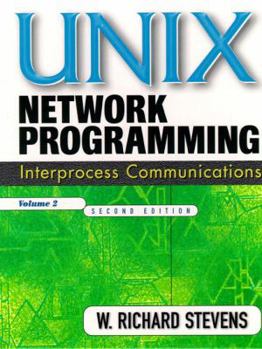
UNIX Network Programming, Volume 2: Interprocess Communications, Second Edition

Select Format
Select Condition 
Book Overview
Well-implemented interprocess communications (IPC) are key to the performance of virtually every non-trivial UNIX program. This book provides coverage of various forms of IPC, including message... This description may be from another edition of this product.
Format:Hardcover
Language:English
ISBN:0130810819
ISBN13:9780130810816
Release Date:August 1998
Publisher:Prentice Hall PTR
Length:400 Pages
Weight:3.05 lbs.
Dimensions:9.8" x 1.8" x 7.5"
Customer Reviews
6 ratings
The real power of UNIX is in communication.
Published by bernie4444 , 3 days ago
The real power of UNIX, or any application for that matter, is in interprocess communication. I found early on that accomplishing any large project would require the cooperation of interprocess communication. Now I find that simple administration skills also require knowledge of this interprocess communication.
My first foray into the field was to use semaphores to flag processes to run at the proper time. Later I needed to use pipes for a front-end in communication to SNA. Again, I found IPCs could help inform and control processes that were in canned packages and not accessible any other way. The list of useful tools can go on and on. I also had to find the NT equivalent as it became popular.
UNIX is still out there in many forms, and if one is to survive in the field, an understanding of interprocess communication is imperative.
The Abbreviated Table of Contents:
Part 1. Introduction
1. Introduction
2. POSIX IPC
3. System V IPC
Part 2. Message Passing
4. Pipes and FIFOs
5. POSIX Message Queues
6. System V Message Queues
Part 3. Synchronization
7. Mutexes and Condition Variables
8. Read-Write Locks
9. Record Locking
10. POSIX Semaphores
11. System V Semaphores
Part 4. Shared Memory
12. Shared Memory Introduction
13. POSIX Shared Memory
14. System V Shared Memory
Part 5. Remote Procedure Calls
15. Doors
16. Sun RPC
Epilogue
Appendix A. Performance Measurements
Appendix B. Threads Primer
Appendix C. Miscellaneous Source Code
Appendix D. Solutions to Selected Exercises
Bibliography
Index
One final note is that, with systems dispersed globally, Remote Procedure Calls are taking precedence in interprocess communication.
If you want to program in Linux you need this book.
Published by Thriftbooks.com User , 19 years ago
Programming UNIX or Linux networks is a piece of cake with these books. You need the set, Vol 1 & 2. As a professional programmer of 20 years I use the book as a refernce for all my new programs. I have used the books to break into the world of VoIP and audio CODEC network programming.
Classic work - but in series need of updates as time goes on
Published by Thriftbooks.com User , 21 years ago
I cannot fathom a guess as to how many times the books in this series have saved my in project work over the years. The only drawback with this series is that some publisher should endeavor to keep them up to date. Serious Unix system programmers must have copies of the complete series.
Five star book on a four star subject
Published by Thriftbooks.com User , 25 years ago
Since anyone considering buying a technical book always needs to know what it covers, here's the table of contents:Part 1. Introduction1. Introduction2. Posix IPC3. System V IPCPart 2. Message Passing4. Pipes and FIFOs5. Posix Message Queues6. System V Message QueuesPart 3. Synchronization7. Mutexes and Condition Variables8. Read-Write Locks9. Record Locking10. Posix Semaphores11. System V SemaphoresPart 4. Shared Memory12. Shared Memory Introduction13. Posix Shared Memory14. System V Shared MemoryPart 5. Remote Procedure Calls15. Doors16. Sun RPCEpilogueAppendix A. Performance MeasurementsAppendix B. Threads PrimerAppendix C. Miscellaneous Source CodeAppendix D. Solutions to Selected ExercisesBibliographyIndexThis is the third and least of Stevens' three books on UNIX programming (he also coauthored a multi-volume work on TCP). It is the not the least because it is necessarily the worst, but because it has the shortest and has the narrowest application domain.Having said it is the least, it remains a work of the highest quality in an industry that is notable for the huge quantity of bad books that it produces. The structure of this book will be familiar to readers of his prior two books: the lowest-level building block around which Stevens structures the book is the individual function call. For each call (or minor variations on a single call), he provides the C prototype, and then, in text, explains what the function does, what it's arguments are for, and then provides a small C program that demonstrates it in action (all of the sample programs can also be downloaded from the web). These function-level building blocks are arranged into related sets, each of which is a chapter in the book. Each chapter has a wrapper that explains the basic concepts behind the functions in that chapter, and some review exercises at the end. The chapters in turn build on each other, with the most basic ones at the beginning and the more difficult ones towards the end.In spite of the book's many positive qualities, one thing that this book brings to light, however, is that there is a thread-sized hole in Stevens' UNIX writings. "Advanced Programming in the UNIX Environment" had a great deal of information about processes, but nothing about threads. "UNIX Network Programming: Volume 1", discussed multi-threaded socket programs, but didn't go into any depth on threading. This volume, although it discusses thread synchronization, only touches on general threading issues. Thus, the works, taken as a group, go into some of the important issues and uses of threading without giving the reader a solid grounding in the subject. As threading increases in frequency, this deficiency has grown in importance.Another difference between this book and its predecessors is that it deals with an area where standards are much weaker than the others; thus, the chapters often have to explain different implementations for accomplishing a task rather than building a basic-to-advanced seque
Comprehensive coverage of diff. interprocess comm. methods
Published by Thriftbooks.com User , 27 years ago
Covers semaphores, mutexes, read write locks, record locks, message queues, pipes and shared memory with extensive examples in C.A must have book along with Vol I for anyone dealing with network programming.
Indespensible!
Published by Thriftbooks.com User , 27 years ago
I found this book invaluable when having to port POSIX code to a SVR4 system. The examples given are obscure, but useful for a serious systems programmer. Having first referenced several other books for the same material, I found there were no comparisons once I picked up UNPv2. A *must have* reference book for Unix systems programmers!
Copyright © 2026 Thriftbooks.com
Terms of Use | Privacy Policy | Do Not Sell/Share My Personal Information | Cookie Policy | Cookie Preferences | Accessibility Statement
ThriftBooks ® and the ThriftBooks ® logo are registered trademarks of Thrift Books Global, LLC
ThriftBooks ® and the ThriftBooks ® logo are registered trademarks of Thrift Books Global, LLC
