


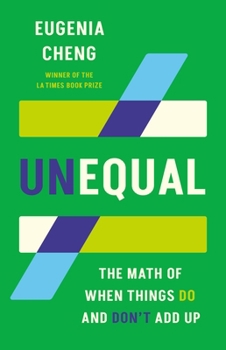
Unequal: The Math of When Things Do and Don't Add Up
No Customer Reviews

Why the familiar equal sign is a gateway into math's--and humanity's--most profound questions
"Eugenia Cheng has opened up my mind to the wondrous world of pure mathematics in a way that I never thought was possible." ―Willow Smith, singer and actress
A New Scientist Best Book of the Year Math is famous for its equations: 1 + 1 = 2, a 2 + b 2 = c 2, or y = mx + b. It can seem like that's all mathematics is: following steps to show that what's on one side of an equation is the same as what's on the other.
In Unequal, Eugenia Cheng shows that's just part of the story, and the boring part to boot. Mathematics is a world of shapes, symmetries, and logical ideas. And in that world, the boundary between things being equal and unequal is a gray area, or perhaps a rainbow of beautiful, vibrant, subtly nuanced color.
As Unequal shows, once you go over that rainbow, almost everything can be considered equal and unequal at the same time, whether it's shapes (seen from the right perspective, a circle is the same as an ellipse), words (synonyms), or people--even numbers That's because mathematics isn't a series of rules, facts, or answers. It's an invitation to a more powerful way of thinking.
"Eugenia Cheng has opened up my mind to the wondrous world of pure mathematics in a way that I never thought was possible." ―Willow Smith, singer and actress
A New Scientist Best Book of the Year Math is famous for its equations: 1 + 1 = 2, a 2 + b 2 = c 2, or y = mx + b. It can seem like that's all mathematics is: following steps to show that what's on one side of an equation is the same as what's on the other.
In Unequal, Eugenia Cheng shows that's just part of the story, and the boring part to boot. Mathematics is a world of shapes, symmetries, and logical ideas. And in that world, the boundary between things being equal and unequal is a gray area, or perhaps a rainbow of beautiful, vibrant, subtly nuanced color.
As Unequal shows, once you go over that rainbow, almost everything can be considered equal and unequal at the same time, whether it's shapes (seen from the right perspective, a circle is the same as an ellipse), words (synonyms), or people--even numbers That's because mathematics isn't a series of rules, facts, or answers. It's an invitation to a more powerful way of thinking.
Format:Hardcover
Language:English
ISBN:1541606558
ISBN13:9781541606555
Release Date:September 2025
Publisher:Basic Books
Length:400 Pages
Weight:1.40 lbs.
Dimensions:1.5" x 6.2" x 9.3"
Customer Reviews
0 rating
Copyright © 2026 Thriftbooks.com
Terms of Use | Privacy Policy | Do Not Sell/Share My Personal Information | Cookie Notice | Cookie Preferences | Accessibility Statement
ThriftBooks ® and the ThriftBooks ® logo are registered trademarks of Thrift Books Global, LLC
ThriftBooks ® and the ThriftBooks ® logo are registered trademarks of Thrift Books Global, LLC
