


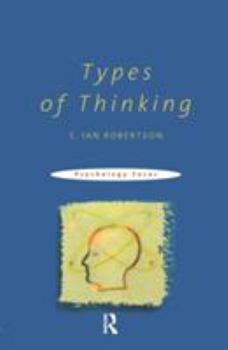
Types of Thinking


Select Format
Select Condition 
Book Overview
Types of Thinking provides a grounding in the psychology of thinking including the practical aspects and applications of everyday thinking, creative thinking, logical thinking, intelligent thinking and even failures/lapses in thinking.
Format:Paperback
Language:English
ISBN:0415191068
ISBN13:9780415191067
Release Date:April 1999
Publisher:Routledge
Length:182 Pages
Weight:0.50 lbs.
Dimensions:0.4" x 5.5" x 8.5"
Customer Reviews
1 rating
Good thinking
Published by Thriftbooks.com User , 24 years ago
'Types of Thinking' aims to provide a basic grounding in the psychology of thinking for, typically, undergraduate students with little previous knowledge of cognitive psychology. It gives a clear overview of the various kinds of thinking, by exploring some of the practical applications of everyday thinking, and discussing creative thinking, logical and scientific thinking, intelligent thinking and machine thinking. There are many examples given which illustrate the various thought processes, for example the fallacious physics of Star Trek, and the failures of thinking - biases and shortcuts - that often lead us astray. In particular, everyday thinking is explored, with its capacity to solve the problems that life presents us with daily, and shows the limitations of our thoughts. One early quotation: 'the only reason why some people get lost in thought is because it's unfamiliar territory' seems particularly apt here. The major differences are exposed between the logical thinking of science and the more chaotic (or divergent - it depends on your viewpoint) thinking of the arts. Creative thinking is dealt with at some length. The ways in which problem are represented is seen as key to giving full flow to creativity. Designers have long been taught that it is how you view the problem that is crucial to a creative outcome. The usual 'stages' of creative thought are outlined (preparation, incubation, illumination, verification/evaluation) together with divergent/convergent modes of thinking. The view taken here is however rather narrow. Some modern theories about for example the kinds of personality that may give rise to creativity, the multiple intelligences that seem to have their outcomes in markedly different fields, the rebellious thinking, risk taking, playfulness, and intuitive thinking, are either dealt with scantily or are dismissed outright. Some richness has perhaps necessarily been lost in providing the overview.The book succeeds well in being entertaining, and perhaps stimulating an appetite for further reading. In this regard, it is well referenced, and has a good glossary of considerable benefit to the student reader. It is a well structured and clear introduction to the subject which no doubt will provide an adequate introduction to the subject for students of psychology and cognate subjects. However, the book is quite accessible by lay readers and would be helpful to all students in understanding the possibilities and limits of their own thinking. S. Ian Robertson (1999) Types of Thinking, Routledge: London. Psychology Focus Series. ISBN 0-415-19105-X (hbk) 0-415-19106-8 (pbk) 167+XIV pages.
Copyright © 2026 Thriftbooks.com Terms of Use
| Privacy Policy | Do Not
Sell/Share My Personal Information | Cookie Policy | Cookie Preferences | Accessibility Statement
ThriftBooks® and the ThriftBooks® logo are registered trademarks of Thrift Books Global, LLC
ThriftBooks® and the ThriftBooks® logo are registered trademarks of Thrift Books Global, LLC
