


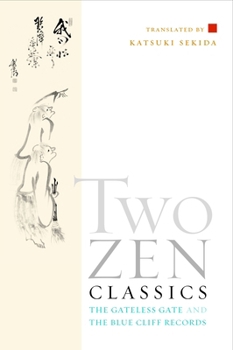
Two Zen Classics: The Gateless Gate and the Blue Cliff Records


Select Format
Select Condition 
Book Overview
A new translation of The Gateless Gate and The Blue Cliff Records , two classic collections of Zen koans--or guiding 'riddles'--used in the study of Zen Buddhism The strange verbal paradoxes called koans have been used traditionally in Zen training to help students attain a direct realization of truths inexpressible in words. The two works translated in this book, Mumonkan ( The Gateless Gate ) and Hekiganroku ( The Blue Cliff Records ), both compiled during the Song dynasty in China, are the best known and most frequently studied koan collections, and are classics of Zen literature. They are still used today in a variety of practice lineages, from traditional zendos to modern Zen centers. In a completely new translation, together with original commentaries, the well-known Zen teacher Katsuki Sekida brings to these works the same fresh and pragmatic approach that made his Zen Training so successful. The insights of a lifetime of Zen practice and his familiarity with both Eastern and Western ways of thinking make him an ideal interpreter of these texts.
Format:Paperback
Language:English
ISBN:1590302826
ISBN13:9781590302828
Release Date:September 2005
Publisher:Shambhala
Length:416 Pages
Weight:1.25 lbs.
Dimensions:1.1" x 6.1" x 9.0"
Customer Reviews
5 ratings
Thought Provoking
Published by Thriftbooks.com User , 16 years ago
I love this book. It is one of those read a section and meditate on the ideas type books. It is a good introduction to classical Zen mind.
Essential to Koan Study
Published by Thriftbooks.com User , 16 years ago
I use The Blue Cliff Record by Thomas Cleary and J.C. Cleary for koan study encounters with my zen teacher. But, when I had special difficulty understanding one of the cases, he recommended Sekida's translation of the case and verse. He was right, Sekida's translation was far clearer, easier to understand. I now refer to both translations for each Koan pointer, case, and verse. I rarely ever find them openly conflicting, but their flavors are very different. Sometimes one is clearest and sometimes the other, What makes Sekida's translation so good? I think it is that he translates from the point of view of a zen student and teacher. Koan study is personal, active, intimate. Sekida's translation most often does it. However, he does tend to paraphrase the original commentary rather than strictly translate it. This can be helpful to understanding the context or background of some cases. The Cleary's do a wonderful job as academics. I have virtually all of their works. All English speaking zen students owe them a great debt of gratitude. But, Sekida often turns a case's verse into an English version of the personal, intimate language of a zen teacher. And the ancient authors were all zen teachers. I recommend a koan student use both books. Often, it is the difference between them that is most instructive.
An excellent study of two of the greatest zen works
Published by Thriftbooks.com User , 20 years ago
Two Zen Classics contains the texts of the two most important koan collections: The Gateless Gate and the Blue Cliff Record. Together with the Book of Serenity, the Transmission of the Light, and the Lin-chi-lu, form the basis of koan study in Zen. For beginners and those unfamiliar with Zen, koans will seem illogical gibberish, and the commentaries on them even more so. Yet for the serious student who wishes to train with koans, this book is an excellent resource. For those who don't know, a koan is a unique piece of writing which expresses the nature of reality in words transcending words. A koan cannot be solved by logic, thus it is not a riddle. Rather, a koan is meditated upon until the intellectual mind reaches its limit, and the desire for understanding forces the mind into a higher level of intuitive realization. The first koan in the Gateless Gate, Joshu's Mu, is still the most commonly used first koan for a student. Koans are tools for meditation, designed to bring about realization. Mr. Sekida provides superb notes for each of 148 koans, giving background information, history, and significance of each koan. Yet, despite the excellence of this volume, it falls short in the same place that all koan translations do. That is, that, though a translator may have a superb understanding of Japanese, the essence of a koan can be lost in the translation. Thus, koan translation is one of the most difficult tasks any translator can undertake. To truly be successful, one would have to be a Zen master of incomparable realization, since it is only with realization that one can thoroughly express the essence of the koan in another language. However, this is still one of the best translations of these two collections, with far more hits than misses. Sometimes, however, I find that Mr. Sekida's thorough notation hinders the study of the koan by expressing his own understanding of it. Thus, while one may read his words and understand the koan intellectually, that intellectual knowledge will hinder one in one's own study of that particular case.
A useful text
Published by Thriftbooks.com User , 20 years ago
All in all, this is a handy text - two 'Zen classics' under one cover.@So far as translation goes, the collaborators (Sekida and Grimstone) have made a fair job of this task. It is well worth reading in conjuction with Sekida's companion work -'Zen Training:Methods and Philosophy.' As a lay-Buddhist himself, Sekida-sensei knew well the sort of problems that layfolk encounter and therefore avoided writing about Zen practice as if it were the prerogative of Zen monks, throwing in little pointers and hints which would help explicate Zen practice for layfolk. In that sense, Sekida's work will remain useful for years to come. In other respects, it must be noted that since this book was published (1977), Thomas Cleary has presented us with what is by far the most complete version of the Hekiganroku or 'Blue Cliff Record.' You might as well know what's been missing. In the introductory chapter to Sekida's text, A.V. Grimstone, Sekida's collaborator, described Shaw's version of the Hekiganroku (1961) as the only other 'complete' translation to date - but, it was not - it had omitted material, mainly Yuan-Wu's.@Regrettably, Sekida also omitted portions of Yuan-wu's (Engo's) material, noting, ironically, that popular Japanese versions of the Hekiganroku often do the same. Grimstone described these missing portions as 'commentaries and notes' - as if that might be taken in the customary sense, and such material comfortably dropped. But, this material did not comprise 'commentaries and notes' in the conventional sense. It was an intrinsic part of the Hekiganroku. The whole Hekiganroku is ?collection of comments, verses, counter-verses and counter-comments.@What Grimstone had been referring to, actually constituted a kind of capping material, intrinsically related to the rest of the Hekiganroku. To put it bluntly, this was messing around.@The Hekiganroku is basically a composite text - Hsueh-t'ou's (Settcho's) hundred verses and verse comments, with Yuan-wu's (Engo's) introductory pointers, verse comments etc. and capping remarks. Of course, Hsueh-t'ou's verse/comments can be considered independently; they were read that way - before the addition of Yuan-wu's material - and are still read that way today, if people so wish. But to present Hseuh-t'ou's verses/verse comments, with fragmentary portions of Yuan-wu's material, was neither one thing nor the other.
A journey deep into the heart of Zen koans
Published by Thriftbooks.com User , 27 years ago
This is a new translation into English both of Mumonkan and Hekiganroku made by a Japanese High School Teacher of English and edited by a Lecturer at the University of Cambridge.The author was enrolled in Zen practice and the study of koans for 72 years. His comments are technical and clear-sighted notes on specific sentences of each koan keeping in mind that the large majority of Zen practitioners all around the world do not study koans in a monastery or under the supervision of a suitable teacher mastering koans. As a consequence it contains a great deal of interpretive material exchanged currently in face-to-face meetings between the teacher and disciple. The author of this translation was a layman, not a monk, and considered koans as an adequate tool for the advancement in the awareness and awakening process and not as occult arcana to held control over students. This book is more comprehensible if the companion book of the author, Zen Training: Methods and Philosophy is read before or simultaneously.
Copyright © 2026 Thriftbooks.com Terms of Use
| Privacy Policy | Do Not
Sell/Share My Personal Information | Cookie Policy | Cookie Preferences | Accessibility Statement
ThriftBooks® and the ThriftBooks® logo are registered trademarks of Thrift Books Global, LLC
ThriftBooks® and the ThriftBooks® logo are registered trademarks of Thrift Books Global, LLC
