


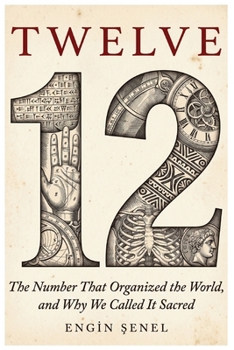
Twelve: The Number That Organized the World, and Why We Called It Sacred
No Customer Reviews

A shepherd in Anatolia and a farmer in Peru counted the same twelve moons in a year. Neither invented it. Neither could have told the other. Twelve runs through human history with a persistence that looks like design. Twelve months. Twelve signs. Twelve tribes, twelve apostles, twelve imams. Twelve gods carved into a Hittite hillside by a people who worshipped a thousand. Twelve stars on the flag of the European Union. The usual explanation is that twelve is a sacred number. This book argues that the truth runs the other way. Twelve divides - into halves, thirds, quarters, sixths - in a world that had no way to write a fraction, and that made it the most valuable organizing tool humanity ever found. It timed the taxes of Solomon's kingdom. It split the wings of a steppe army. It cut the sky into signs. And a number that works everywhere, in domains that share nothing else, does not look like arithmetic to the people using it. It looks like proof of an order behind the world. Drawing on Sumerian accounting, Babylonian star catalogues, the eleventh-century Turkic dictionary of Mahmud of Kashgar, Roman law, Maya mathematics and the reliefs at Yazılıkaya, TWELVE traces how a practical solution became a sacred one - and why, when the French Revolution set out to decimalize the world, the twelve-month year was the one thing even the revolutionaries could not bring themselves to touch.
Format:Paperback
Language:English
ISBN:B0HD2DZKB3
ISBN13:9798190407501
Release Date:August 2026
Publisher:Independently Published
Length:154 Pages
Weight:0.47 lbs.
Dimensions:0.4" x 6.0" x 9.0"
Customer Reviews
0 rating
Copyright © 2026 Thriftbooks.com
Terms of Use | Privacy Policy | Do Not Sell/Share My Personal Information | Cookie Policy | Cookie Preferences | Accessibility Statement
ThriftBooks ® and the ThriftBooks ® logo are registered trademarks of Thrift Books Global, LLC
ThriftBooks ® and the ThriftBooks ® logo are registered trademarks of Thrift Books Global, LLC
