


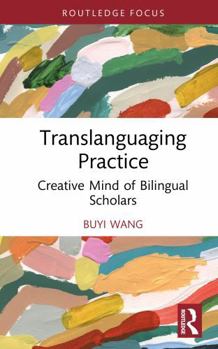
Translanguaging Practice: Creative Mind of Bilingual Scholars

This book explores how bilingual academics draw on their full linguistic, cultural, and semiotic repertoires to conduct, communicate, and publish scholarly work. It challenges monolingual ideologies and language-separation mindsets in second language education.
The author presents a theoretical framework and a literature review of translanguaging theory and its relationship to the professional activities of bilingual scholars. Through a narrative inquiry with three in-depth case studies, it investigates how Chinese-English bilingual scholars deploy their bilingual resources in teaching, research, and academic writing. Rooted in a sociocultural perspective on literacy, the book reframes bilingualism as a professional asset and a source of scholarly innovation. It argues that bilingual academics should be recognised not as exceptions but as models of a growing multilingual norm in higher education.
The book will appeal to scholars and students of applied linguistics, bilingual/multilingual education, and higher education.
Customer Reviews
ThriftBooks ® and the ThriftBooks ® logo are registered trademarks of Thrift Books Global, LLC
