


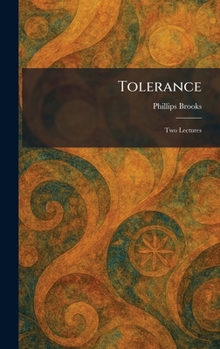
Tolerance: Two Lectures

"Tolerance Two Lectures" explores the delicate balance between deep personal conviction and the broad spirit of tolerance. Delivered by the renowned clergyman Phillips Brooks, these lectures delve into the philosophical and religious underpinnings of how individuals can hold firm to their truths while respecting the differing views of others. Brooks argues that true tolerance is not a result of indifference or a lack of belief, but rather a sophisticated virtue that grows out of a profound faith and a respect for the complexity of human experience.
Through his insightful prose, Brooks examines the historical and spiritual development of tolerance, tracing its evolution from mere endurance to a positive, active appreciation of diversity in thought and practice. He addresses the challenges of maintaining one's integrity in a pluralistic society and provides a compelling vision for a more inclusive and understanding religious community. These lectures remain a vital contribution to the discourse on ethics and theology, offering timeless wisdom on how to bridge divides through empathy and intellectual humility. "Tolerance Two Lectures" serves as an essential resource for readers interested in the history of religious thought and the ongoing pursuit of social harmony.
This work has been selected by scholars as being culturally important, and is part of the knowledge base of civilization as we know it. This work was reproduced from the original artifact, and remains as true to the original work as possible. Therefore, you may see the original copyright references, library stamps (as most of these works have been housed in our most important libraries around the world), and other notations in the work.
This work is in the public domain in the United States of America, and possibly other nations. Within the United States, you may freely copy and distribute this work, as no entity (individual or corporate) has a copyright on the body of the work.
As a reproduction of a historical artifact, this work may contain missing or blurred pages, poor pictures, errant marks, etc. Scholars believe, and we concur, that this work is important enough to be preserved, reproduced, and made generally available to the public. We appreciate your support of the preservation process, and thank you for being an important part of keeping this knowledge alive and relevant.
Customer Reviews
ThriftBooks ® and the ThriftBooks ® logo are registered trademarks of Thrift Books Global, LLC
