


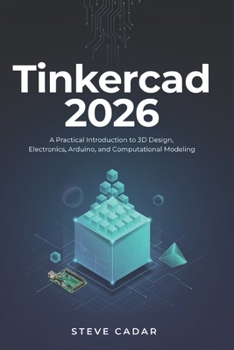
Tinkercad 2026: A Practical Introduction to 3D Design, Electronics, Arduino, and Computational Modeling

Tinkercad 2026
A Practical Introduction to 3D Design, Electronics, Arduino, and Computational Modeling
Author:
Steve Cadar
The book covers the major areas a learner needs to understand when using Tinkercad for practical digital design and STEM learning. It introduces the Tinkercad workspace and 3D design process before progressing into shapes, measurements, alignment, grouping, duplication, text, imported designs, and model organization. It also explores Tinkercad Circuits, including electronic components, circuit construction, Arduino programming, sensors, LEDs, motors, simulation, debugging, and interactive projects.
The book further examines Codeblocks and computational 3D modeling, introducing variables, functions, loops, conditional logic, mathematical operations, coordinates, algorithmic design, reusable design structures, and export workflows. It also addresses Tinkercad's educational applications, including classroom activities, assignments, assessment, collaboration, project sharing, STEM projects, and responsible digital practices.
Why the Book Is ImportantTinkercad provides learners with a practical way to explore ideas that can otherwise seem difficult when introduced only through theory. By combining 3D modeling, electronics simulation, Arduino programming, and computational design, learners can experiment with concepts, test solutions, identify mistakes, and refine their work in a digital environment before moving toward physical construction.
The practical approach of this book helps readers understand how different technical concepts connect rather than treating each feature as an isolated tool. A learner can move from creating a basic 3D model to developing a circuit, programming an Arduino-based system, or constructing a computational design using Codeblocks. This makes the material useful for students, educators, hobbyists, aspiring designers, and anyone developing foundational STEM skills.
Why This Book Is a Good Fit for ReadersThis book is particularly suitable for readers who want a structured introduction without being overwhelmed by unnecessary technical complexity. The material progresses from fundamental concepts toward more involved applications, allowing readers to build understanding gradually.
Readers can use the book to:
Develop foundational 3D modeling skills.Understand essential Tinkercad design tools and workflows.Build and simulate electronic circuits.Explore Arduino programming and interactive projects.Work with sensors, LEDs, motors, and other circuit components.Understand Codeblocks and computational modeling.Apply variables, loops, conditions, and mathematical logic to designs.Develop systematic problem-solving and design habits.Explore Tinkercad's role in STEM education and project-based learning.Connect digital models and simulations with practical design concepts.The book is therefore not simply a collection of feature explanations. Its broader purpose is to help readers develop confidence through experimentation, structured problem-solving, and repeated practice. It provides a foundation that readers can continue building upon as they explore more sophisticated CAD, electronics, programming, robotics, and digital fabrication concepts.
Customer Reviews
ThriftBooks ® and the ThriftBooks ® logo are registered trademarks of Thrift Books Global, LLC
