


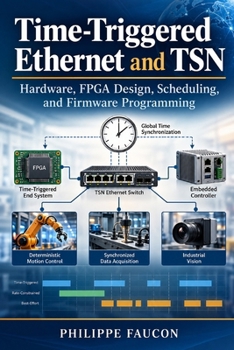
Time-Triggered Ethernet and TSN: Hardware, FPGA Design, Scheduling, and Firmware Programming

Hardware, FPGA Design, Scheduling, and Firmware Programming
Learn how deterministic Ethernet works-and how to implement it in real embedded systems.
Conventional Ethernet provides high bandwidth and reliable communication, but it does not automatically guarantee when critical data will arrive. Industrial automation, avionics, motion control, and other real-time applications require more predictable communication.
Time-Triggered Ethernet and TSN is a practical engineering guide to the technologies, hardware architectures, and programming techniques used to achieve deterministic Ethernet communication.
Written for FPGA engineers, embedded software developers, firmware programmers, and system architects, this book bridges the gap between networking standards and real hardware implementation.
Rather than focusing exclusively on protocol theory, it explains how Ethernet PHYs, MAC controllers, synchronized clocks, DMA engines, traffic queues, and transmission schedulers work together-and how engineers configure and program these components.
Inside this book, you will learn how to:
Understand Ethernet latency, jitter, contention, and worst-case timing.
Compare AFDX, TTEthernet, and IEEE Time-Sensitive Networking (TSN).
Understand IEEE 1588 PTP, IEEE 802.1AS gPTP, and SAE AS6802A synchronization.
Configure TSN mechanisms including time-aware scheduling, credit-based shaping, policing, frame preemption, and redundancy.
Design deterministic transmission schedules and calculate guard bands.
Select TSN-capable controllers, Ethernet switches, and FPGA IP.
Build FPGA architectures with hardware clocks, timestamp engines, queues, and scheduling logic.
Program Ethernet controllers through registers and manage DMA descriptors.
Develop deterministic Ethernet drivers in C.
Use Linux TSN interfaces including tc taprio, etf, PTP hardware clocks, and SO_TXTIME.
Measure latency, jitter, clock accuracy, missed transmission slots, and synchronization recovery.
Understand the design of a two-node TSN system and evaluate practical implementation tradeoffs.
From networking concepts to register-level programming
The book progresses from Ethernet fundamentals through time synchronization and traffic scheduling to FPGA design, low-level C programming, Linux integration, and timing verification.
Practical examples include hardware register maps, C driver interfaces, scheduling calculations, configuration commands, and system-level test procedures.
A final engineering comparison examines when AFDX, TTEthernet, or TSN is the most appropriate choice based on timing requirements, fault tolerance, hardware availability, certification considerations, and development effort.
Who should read this book?
This guide is intended for engineers and technically experienced readers working with:
FPGA and SoC development
Embedded C and firmware programming
Ethernet MAC and PHY interfaces
Industrial real-time networking
Avionics and aerospace communication systems
TSN-capable Ethernet switches and controllers
Deterministic control and data-acquisition systems
Whether you are evaluating a TSN controller, developing FPGA networking logic, writing an Ethernet driver, or designing a time-sensitive embedded network, this book provides a structured engineering foundation for understanding and implementing deterministic Ethernet.
Go beyond Ethernet protocols. Understand the hardware, program the controller, and engineer predictable communication.
Customer Reviews
ThriftBooks ® and the ThriftBooks ® logo are registered trademarks of Thrift Books Global, LLC
