Skip to content
Scan a barcode
Scan
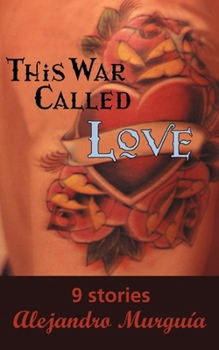
Paperback This War Called Love: Nine Stories Book

ISBN: 0872863948

ISBN13: 9780872863941

This War Called Love: Nine Stories

Select Format

Select Condition ThriftBooks Help Icon

Recommended

Format: Paperback

Condition: Like New

$9.69
Save $6.26!
List Price $15.95
Almost Gone, Only 1 Left!
Save to List

Book Overview

From Mexico City to San Francisco's Mission District, nothing comes easy--in life or in love. Here is an unstereotypical view of a world as treacherous as it is tender, as hilarious as it is heartbreaking. Authentic and honest, these nine stories focus on today's Latino men, their strength and vulnerability, their fears and deepest desires.

"Danger, cruelty, lust, loss, blood, death and dance. . . . Couldn't put the book down. So hot I had to smother it in half and half. Murgu a's a master of hearts on fire, working his storytelling anvil late at night, in a wrecked cubicle of SF called La Mission. No doubt the hungriest fiction and the most ferocious collection in the last three decades."--Juan Felipe Herrera, author of Border Crosser with a Lamborghini Dream

"Alejandro Murgu a has returned the short story to the people. Though some of his characters are down on their luck, the author has hit the literary jackpot with this one. He's been revered as an artist for decades among the multicultural cognoscenti, and the publication of this fabulous volume will confirm for many readers what we knew all along."--Ishmael Reed, author of The Reed Reader

"This is a book of rare intensity and transcultural joy "--Jos David Sald var, author of Border Matters: Remapping American Cultural Studies

"The nine tales of life in Mexico City and the Mission District depicted . . . crackle with energy without losing sight of their narratives. . . . Murguia's] Mission district is not a hipster haven but a melting pot for Latinos from all over the Americas, and his Mexico City is a thriving cultural whirlwind."--San Francisco Chronicle Book Review

"Alejandro Murgu a begins This War Called Love: Nine Stories, his second collection, with an unforgettable portrait of Mexico City in the summer of 1956. Murgu a's prose has the captivating quality that can only flow from a narrator who is himself captivated by his passions. A born storyteller, Murgu a sustains flawlessly believable first-person narratives, which gives his prose much of its warmth and nuance."--The San Francisco Bay Guardian

"Equal parts funny and sad, Murgu a's short stories depict, with tender and sometimes unflinching detail, love, life, and growing up Hispanic. . . . Although the best of the collection are on the darker side, Murgu a also shines in the more lighthearted stories . . . Free of stereotypes and always honest, this collection presents Latino Chicano life at full throttle."--Booklist

"Authentic and honest, these stories focus on today's Latin men, their strength and vulnerability, their fears and deepest desires."--Latin Style

Alejandro Murgu a was born in California, but raised in Mexico City. His experiences as an international volunteer in the Nicaraguan Insurrection of 1979 are recounted in his second collection of short stories Southern Front (American Book Award, 1991). He lives in San Francisco, where he teaches Latin American literature at San Francisco State University.

Customer Reviews

2 ratings

This War Called Love

Mr. Murguia is an excellent writter as well as an excellent teacher. He brings us into the story by sending vivid pictures into our mind and letting us experience exactly what the charater is feeling. I feel that my family could relate to it as well. I enjoyed the book and would recommend it to anyone.

Instructs and Delights

Thsee stories show us a part of the real world, rather than isolated characters on a literary stage. Murguia's narrators are story-tellers, and their voices are wildly varied, but each so dead-on that reading is hearing them talk. Reading is easy despite Murguia's elaborate blending of ideas, feelings, and information. In "El Ultimo Round," for example a pair of movement cognoscenti hash out their politics drunk as skunks on the freeway. You could use the book to learn a little Mexican Spanish or history or get a modern male view about love. Some of the stories are set-pieces. A very short one about a little boy selling roses reminded me of the moment in A Streetcar Named Desire when the heroine opens the door and sees an old woman calling "flores para los muertos -- flowers for the dead." She slams the door, realizing she can't just walk out on her dysfunctional family; there's just one escape from her dysfunctional self. Moments like that risk becoming sops to a reader's conscience (we all face death, so what's a little oppression here and there...). Murguia dodges this risk by rooting his characters firmly in the real world. In the first story, a boy's dreamy cinematic image of his actress mother broods over the earthquake-transfigured city, but we and he spend most of our time with the facts of boyhood friendships, fights and betrayals, the vanished neighborhoods, and the history of Mexican cinema. Murguia can celebrate the poor without romanticizing. In Ofrendas, the Day of the Dead in the Mission district comes through in its full seasoned exuberance. In A Lesson in Merengue, the dance instructor lets us know merengue can be fun, but can also mean getting grabbed by some random guy and going through the steps as fast as you possibly can until your feet and back are killing you. In Lucky Alley when a man rips off the woman he genuinely loves, even he knows she ought to leave, but we still wish she would come back. This one has the most skillful ending for a love story I've read in a long time. Most of the writing is plain and direct, but word games and ironies lie just under the surface. A Toda Maquina has a guy fall against all odds in love, while heading with a stash in the back of his truck toward what he calls El Ley, which is LA, not a little desert town named Law. There's a fair amount of Spanish, unitalicized, but most of the Spanish words are cognates or well known, or Murguia tips off the reader, unless they're curses. Toning down English dialog is something every writer does (just count the f's dropped in a typical coffee shop chat versus a typical novel these days). Here the Spanish gets away with more, which can create an impression that Spanish is the natural language of the unmentionable, one of the many subtle risks facing work like Murguia's, that can only be overcome by more books like his.
Copyright © 2026 Thriftbooks.com Terms of Use | Privacy Policy | Do Not Sell/Share My Personal Information | Cookie Notice | Cookie Preferences | Accessibility Statement
ThriftBooks ® and the ThriftBooks ® logo are registered trademarks of Thrift Books Global, LLC

GoDaddy Verified and Secured