


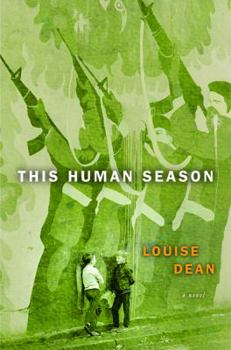
This Human Season


Select Format
Select Condition 
Book Overview
It's not personal, he says. But that's a lie in a place where everything is personal, and a matter of life and death too. This Human Season is award-winning Booker longlisted author Louise Dean's... This description may be from another edition of this product.
Format:Hardcover
Language:English
ISBN:0151012539
ISBN13:9780151012534
Release Date:January 2007
Publisher:Houghton Mifflin Harcourt
Length:374 Pages
Weight:0.20 lbs.
Dimensions:9.5" x 1.5" x 6.0"
Related Subjects
Contemporary Fiction Genre Fiction Historical Literary Literature & Fiction PoliticalCustomer Reviews
5 ratings
Thoroughly engaging and worth your time
Published by Thriftbooks.com User , 17 years ago
I picked up this book on a whim in a used book store and am very glad I did so. I knew enough about the historical context to be engrossed in the story, but not enough to be bothered by some of the small errors or omissions that troubled other reviewers here. Dean's characters drew me in from the first page, and I was reluctant to put the book down. Every single character was flawed, sometimes deeply, and yet compelling. The blurb on the back of the book marvelled at the balance Dean achieved in treating the two sides of the conflict. I would agree, though if pressed I would say she's a bit gentler with the Catholics. But only a bit. I thought I foresaw the climax of the story, and I was thoroughly wrong. That's not the only mark of a good read, but it's on the list. If the premise of this book interests you, it is well worth your time.
Exceptionally Well Done
Published by Thriftbooks.com User , 17 years ago
This is an excellent book detailing life in Belfast during a few months in 1979. The dialogue, the exposition, the plot all are just superb. I hope Mrs. Dean writes many many books-she is a great writer!
"You're already involved, aren't you, just by living here; so you might as well try and do something
Published by Thriftbooks.com User , 18 years ago
Set in Belfast, this novel by Louise Dean focuses on the sectarian violence between Republicans and Loyalists, Catholics and Protestants, which reaches its irrational peak in the winter of 1979, and she holds back nothing in describing the brutality and tit-for-tat horrors in which both sides engage. For three years, a major protest has been going on inside The Maze, the famed prison in Long Kesh, where sadistic guards turn the miseries of prison life into horrific, inhuman conditions. In an almost clinical recitation of scenes so gross that many readers will prefer not to read them, she describes conditions, which prisoners have deliberately made worse. They refuse to wear prison uniforms, wearing no clothes at all and wrapping themselves in their blankets. They refuse to use latrines, filling their cells and halls with excrement and creating a stench so intense that guards cannot scrub it off their bodies. Desperate for public attention for their modest demands, which have been ignored, they are about to engage in a hunger strike, the pivotal event for the action here. Putting a human face on the turmoil, the novel focuses on two families--the Morans, whose teenage son Sean has been sentenced to sixteen years at Long Kesh, and John Dunn, a 39-year-old former British soldier who has just started work as a guard. Dunn has recently connected with the British son he never knew, born out of wedlock, a young man about the same age as Sean Moran. Dean uses parallel scenes (most touchingly, at Christmas) to show how much, on the human level, these two families have in common. Dean illustrates the conditions and the thinking of the time as the minimal plot unfolds. Kathleen Moran, Sean's mother, becomes involved with the Relatives Action Committee. Their local priest is at odds with some other priests because he supports the hunger strike and protest. Sinn Fein is represented both inside and outside the prison, and one prisoner, who maintains IRA control within the prison, also directs retaliatory murders on guards outside the prison, in their own homes or neighborhoods. Historical events are paramount, more than just a framework for the novel, and the reader develops a sense of horror about these events. There is little sense of identification with characters, however. The hard-case attitudes of the prisoners allow little room for character development, and the many guards, while having individual quirks, are not well differentiated. The character who comes closest to capturing the reader's interest is Dunn, but the author creates such obvious forboding about his fate and that of the other guards that many readers will be wary of becoming involved. Though the characters here are vehicles through whom information is conveyed, rather than a focus of the novel for their own sakes, Dean creates a powerful picture of seminal events--certain to interest many students of Irish history. n Mary Whipple
(4.5) "It is not those who can inflict the most but those who can suffer the most who will conquer."
Published by Thriftbooks.com User , 19 years ago
This wonderfully-crafted novel addresses the surreal contrast between the warring factions in 1979 Belfast, Catholics battered by years of violence in the name of the cause, the Brits reacting with determined force, barging into rebel homes in search of contraband. All is writ in the language of occupation, one side fighting for a united Ireland, the other imposing English law, families caught in the middle, their loyalty unassailable, their children learning of war instead of the easy camaraderie of childhood. Sean Moran has been arrested in the death of an English soldier, sent to Belfast's Maze Prison, where he "takes the blanket", joining a group of rebels who refuse to wear prison clothing and paint the walls of their cells with excrement. Kate Moran is reeling from her oldest son's incarceration, the entire family charged with anxiety as British soldiers rampage through their home searching for weapons. Kate's husband, the senior Sean, continues to hide in the comfort of the bottle, rehashing his old war stories, proud that his son is a soldier for the cause. In contrast to this family caught in the grinding jaws of cycling violence, Englishman John Dunn reports daily to the Maze, plodding through foul-smelling shifts where the other guards survive by fortifying themselves with drink. Stunned by the cavalier brutality and lack of discipline around him, John is carefully watched by his fellow guards for weakness or signs of empathy with the enemy, working long, depressing hours, his home life suffering from lack of attention. An "us or them" mentality prevails, the Maze a black hole of bare subsistence, the incarcerated rebels determined to change their status from criminals to prisoners of war. The result is pure bedlam, the beliefs of each faction polarizing and demeaning to all, the guards lurking in the same filthy hell as their prisoners: "The moment you've put on that uniform on, you are a target." Finally, For Dunn, hope appears in the person of his son Mark, born of a casual acquaintance years earlier. It is John's connection with this young man that pulls him from the depressing tedium of his job, offering an opportunity to experience the rewards of fatherhood. Against an implacable foe with no end in sight, the Moran's play out their drama, trapped by the circumstances of time and place. Simultaneously, John Dunn lives his personal nightmare as a prison guard, his life threatened, family dynamic in constant flux. Through the two households, Dean explores the effects of long-term conflict and the damage done to the social fabric of a warring city, each side locked into preordained battle lines. It is the inevitability of violence that defines Belfast in 1979, with no room for negotiation, the citizens traumatized by a harsh existence with few rewards. The contrast between the two sides is striking, immutable, a long struggle cast in black and white. The crux: "You can't change anyone's mind by killing them." The essence of t
Northern Irish life in led in & out of prison, late 1979
Published by Thriftbooks.com User , 20 years ago
A friend from Ballymurphy recommended this to me, a novel that takes place around Christmas 1979 as seen through two characters who never meet: Kathleen Moran, a West Belfast mother, wife, and weary at the age of 40, with one son contemplating the looming choice to go on hunger strike in Long Kesh prison. There, guard John Dunn, a veteran of the British Army who has already done three tours in the North of Ireland, decides to work for the increased pay given for such hazardous duty, not only on the inside, but as a target outside the walls from both embittered Loyalists as well as hostile Republicans. Dean tells these two tales well. She avoids cliche, does not show off an overly literary style, preferring to keep more inside, via indirect narration, the perspectives largely limited to Kathleen and John. As the novel progresses, we begin to see more about their partners, their pasts, their relatives, and the reasons they both choose to endure the North rather than flee for less embattled, more leisurely, climes. The alternation, every chapter, of their two stories helps avoid melodrama or predictability. By no means a "Troubles thriller" or a hackneyed hand-wringing liberal plaint, the author--as her acknowledgments show in the appendix, has by interviewing and listening to the real people who lived through this time been able to mix their experiences into fiction that passes for fact, as limited to two frail people recognizably very human. While I in turn recommend this book, a few very minor points prevented it from earning a full five stars. Twice the names of Cardinal O Fiach and the first name of Eamon[n] are misspelled--this shows a shortsighted editor; the misspelling of the area of Twinbrook, again a miniscule slip, again makes me wish a bit more attention had been paid to such telling details so that they rang as true as possible. Some of the supporting characters, such as Lingard's wife, the priest Father Pearse, Brendan the Sinn Fein publicist, and O'Malley the IRA OC, perhaps based on real folks, do not always share the same depth as the main characters, and therefore leave the reader a bit let down. Finally, there is what seems to be a half-visible subplot about Loyalists having been attacked by the guards and the resulting backlash from those on the outside against John and his colleagues that remains too vaguely developed. In closing, this book effectively avoids what I thought would be the pat ending, and Dean, nearly to the conclusion, manages to freshen up what has by now decades on become its own often all too predictable genre of British literature. The pace does weary just short of the finish line. Yet, the two leading characters, by their refusal to become either plaster saints or evil figurines, earn the reader's trust and empathy.
Copyright © 2026 Thriftbooks.com Terms of Use
| Privacy Policy | Do Not
Sell/Share My Personal Information | Cookie Policy | Cookie Preferences | Accessibility Statement
ThriftBooks® and the ThriftBooks® logo are registered trademarks of Thrift Books Global, LLC
ThriftBooks® and the ThriftBooks® logo are registered trademarks of Thrift Books Global, LLC
