


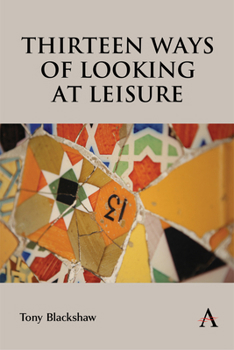
Thirteen Ways of Looking at Leisure

Reimagines its topic through Wallace Stevens's radical aesthetics, recovering its ancient, transcendent essence to reveal that leisure is the basis of all eventful creative action: interpretation, culture, social life, and politics.
In this distinctive title, Tony Blackshaw revitalises the study of leisure, advancing an original reading of this oldest of ideas and a constructive new conception for our era.
Borrowing its structure, presentation and epistemology from Wallace Stevens's philosophical poem, 'Thirteen Ways of Looking at a Blackbird', this book might sound uncomplicatedly like it is going to be an 'introduction' or a 'primer', but it is distinct from both in that it typifies Stevens's direction for a 'paralogy' which contradicts the instructions of conventional thinking. Divided into thirteen theses, it offers its readers a mosaic of tilting fragments, informing one another, bringing a double perspective, past and present, to bear on its topic, offering its readers a Platonic anamnesis of what about leisure in its scholarly study has been effaced and what is yet to be found.
Using Stevens's radical aesthetics and innovative style as a foil, Blackshaw recovers something very old that alludes to the creative chaos of the cosmos before time and space, of what it is about leisure we continue to find magical, that draws us in, and enables us to step outside ourselves into an ekstasis, into another kind of world, which appears to have been lost in its academic study. Drawing on these insights, he carefully and skilfully transforms his subject to show that leisure is the basis of all eventful creative action: interpretation, culture, social life, and politics.
Remarkably illuminating, this book brings back to scholarly awareness the old, to produce the new.
Customer Reviews
ThriftBooks ® and the ThriftBooks ® logo are registered trademarks of Thrift Books Global, LLC
