
Skip to content
Scan a barcode
Scan
Paperback Theory of Geostationary Satellites Book

ISBN: 9401076626

ISBN13: 9789401076623

Theory of Geostationary Satellites

Select Format

Select Condition ThriftBooks Help Icon

Recommended

Format: Paperback

Condition: New

$219.99
Ships within 2-3 days
Save to List

Book Overview

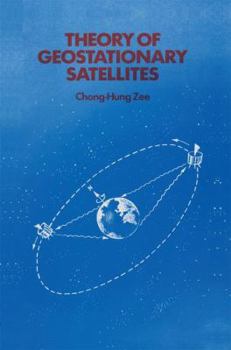
Geostationary or equatorial synchronous satellites are a daily reminder of our space efforts during the past two decades. The nightly television satellite weather picture, the intercontinental telecommunications of television transmissions and telephone conversations, and the establishrnent of educational programs in remote regions on Earth are constant reminders of the presence of these satellites. As used here, the term 'geo- stationary' must be taken loosely because, in the long run, the satellites will not remain 'stationary' with respect to an Earth-fixed reference frame. This results from the fact that these satellites, as is true for all satellites, are incessantly subject to perturbations other than the central-body attraction of the Earth. Among the more predominant pertur- bations are: the ellipticity of the Earth's equator, the Sun and Moon, and solar radiation pressure. Higher harmonics of the Earth's potential and tidal effects also influence satellite motion, but they are of second- order when compared to the predominant perturbations. This volume deals with the theory of geostationary satellites. It consists of seven chapters. Chapter 1 provides a general discussion including a brief history of geostationary satellites and their practical applications. Chapter 2 describes the Earth's gravitational potential field and the methodology of solving the geostationary satellite problem. Chapter 3 treats the effect of Earth's equatorial ellipticity (triaxiality) on a geostationary satellite. Chapter 4 deals with the effects of the Sun and Moon on the satellite's motion while Chapter 5 presents the combined influences of the Sun, Moon and solar radiation pressure. Chapter 6 describes various station-keeping techniques which may be used to make geostationary satellites practically stationary. Finally, Chapter 7 describes the verification of the theory developed in Chapters 3, 4 and 5 by utilizing the Early Bird synchronous satellite observed data as well as its numerically integrated results.

Customer Reviews

0 rating
Copyright © 2026 Thriftbooks.com Terms of Use | Privacy Policy | Do Not Sell/Share My Personal Information | Cookie Policy | Cookie Preferences | Accessibility Statement
ThriftBooks ® and the ThriftBooks ® logo are registered trademarks of Thrift Books Global, LLC

GoDaddy Verified and Secured
