


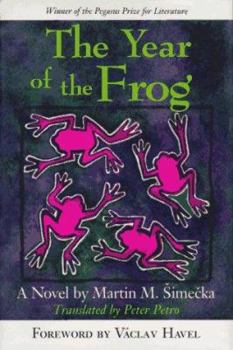
The Year of the Frog: A Novel (Pegasus Prize for Literature)


Select Format
Select Condition 
Book Overview
Set in Bratislava, Czechoslovakia, in the 1980s, Martin Simecka's stunning first novel, The Year of the Frog, portrays a young man struggling to come to terms with his circumstances in the last days... This description may be from another edition of this product.
Format:Hardcover
Language:English
ISBN:0807118699
ISBN13:9780807118696
Release Date:January 1993
Publisher:Louisiana State Univ Pr
Length:240 Pages
Weight:1.36 lbs.
Dimensions:9.3" x 1.0" x 6.3"
Related Subjects
Contemporary Education & Reference Fiction Genre Fiction Literary Literature & Fiction PoliticalCustomer Reviews
4 ratings
A moving tribute to human resilience under inhuman tyranny
Published by Thriftbooks.com User , 22 years ago
In the Czechoslavakian city of Bratislava during the 1980s, young Milan spends his days practicing his long-distance running, tormenting himself over the insecurities caused by his relationship with his girlfriend Tania, and gazing longingly across the banks of the Danube to the relatively liberated Austrian terrain. With his father in prison for insurrectional activity and his diabetic mother gradually losing her grip on sanity, Milan is denied the opportunity of college education and he wanders from job to job--taking work only when the danger of arrest for idleness becomes too great. Under constant police surveillance, he works first as an untrained assistant to neurosurgeons, then as a clerk in a comically undersupplied and overstaffed hardware store, and finally as a nurse's assistant in a maternity ward. Still, amidst the absurdity of totalitarianism, Milan finds splendor and happiness: in Tania, in the woods, in his friends. "The fact that we lived in Europe seemed to me beautiful, even though it had to be in a screwed-up country where I felt happy when someone was finally released from prison." In spite of his lack of enthusiasm, Milan tries to find meaning in his employment: "Why go to America, when I can find my freedom in Bratislava? Is it not an expression of freedom when you help save someone's life?" So he is especially haunted when incompetence, infirmity, or misfortune prevents many of his patients from recovering. The scenes in the operation room, both in the first and last sections of the book, are both enthrallingly lyrical and cringingly graphic. (Full disclosure: I'm the type of wuss who can't even bring himself to watch the surgery scenes during "E.R.") In this topsy-turvy world, it becomes hard to distinguish between sin and morality, stupidity and reason, innocence and guilt. "The more unjust it got, the more innocent and pure I felt, and up to now no one, including myself, has been able to find the tiniest fault with me. Maybe all these people are stupid and the government alone is right. Government employees have always told me that I've gotten what I deserved. . . . Maybe they've seen the future sins of which I'm still unaware." At its heart, "The Year of the Frog" is a love story against the odds, and, ultimately, Milan refuses to let the futility of his situation overwhelm his feelings for Tania and his desire to live happily. Even after the devastating trauma of the final scene, the love he and Tania have for each other triumphs over the hatred the state has for its citizens. American readers might be perplexed by a few scattered literary allusions and historical references, and occasionally the author seems to sacrifice clarity for overwrought symbolism (and part of the trouble might well be the difficulties inherent in translation--which for the most part is surprisingly fluent). Nevertheless, Simecka's narrative is remarkably accessible, often lighthearted, and earnestly rebellious. The result is a moving tribu
A great coming of age story
Published by Thriftbooks.com User , 22 years ago
When the state rejects his application for admission to university, Milan knows well enough to not blame his own talents. Milan is about twenty and growing up in Czechslovokia in the years prior to the Velvet Revolution. He understands and accepts that his imprisoned father's political activity disqualifies him for an advanced education. While this separates Milan from the paths of his friends, he does not dwell on this problem. Instead, he takes a series of disparate jobs (surgeon's assistant, hospital orderly, hardware store clerk) and devotes his attentions to his running and to his girlfriend, Tania. Milan is a very likeable character and his reflections make this book worth reading. The use of these reflections, I supposes, gives this novel a place in the traditional of realism. Milan needs to decide how he feels about Tania. Given that most of his peer group is going ahead with university, he wonders if he is an adequate partner for Tania. He discovers that other people find her attractive. He needs to determine if he is willing to withdraw in the face of the constraints on his life.He needs to reconcile his aspirations for a career and for running. He realizes that running, in spite of his talent for it, will never really amount to something that makes a difference in people's lives. Suddenly, this becomes a barometer for him -- the worth of his actions for others. This is a turning point, his decision to shift from insularity into interdependence. The rest of the story witnesses the change in his attitudes play out in changes with how he views Tania, his work, and his future. While the end of the story does not come with a cliched feel-good event, I still expect that Milan is better off for what has transpired during the period of time in these pages. In fact, maybe that's all the better. The choice of a title refers to two isolated incidents involving a freak outbreak in the population of frogs around Bratislava that year. It has little to do with the real meat of the novel. In a way, I think that the title gives readers the wrong impression about this book. This is not a trifling novel but a great coming of age story.My edition also features a foreword from Vaclav Havel.
The Year of the Frog
Published by Thriftbooks.com User , 26 years ago
This book is about a young man, Milan, in Bratislava, Czechoslovakia during the 1980's. His father is imprisoned as a dissident, Milan is a non-conformist and the Communist state is not his friend. Milan is in turns a hospital orderly and a hardware store clerk, when he is working. The story is intensely personal involving the reader in Milan's thoughts and feelings as he is confronted by the shocks of his eventful life. The story provides insight into the dreary and oppressive life during that period, but more importantly the author is able to make the reader feel the impact of the sometimes ordinary, sometimes traumatic events Milan experiences, and to make his discoveries, joys and anguish our own. It is philosophical as the main character tries at all turns to extract meaning and personal guidance from what he witnesses. It is also very much a love story and shows the great awe and mystery he finds in his girlfriend, Tania, and other women. This is not always pleasant to read but is gripping in the way that it unfolds his hazardous life without disclosing where it is going, if indeed it is going anywhere.
Introduction to Bratislava, Soviet-style
Published by Thriftbooks.com User , 26 years ago
Milan, a twenty-something Bratislavian native, comes of age in this novel of life under Soviet rule. His father, imprisoned for political dissidence, is the reason that our hero is forbidden to go to college and is thus sentenced to a life of toilsome jobs. Divided into 3 chronological parts, we watch our hero: forever jogging and forever thinking--mature into a young man, but change and grow bitter in the process as well. A lot is packed into Simecka's slim novel. Milan's love affair with Tania is the only thing that keeps him going at times as he attempts to cope with his father's incarceration and his mother's chronic depression. The reader gets to learn a lot about Bratislava, warts and all, like the smog being so thick there that getting a tan is nigh impossible at times, or that the smog even prevents one from seeing the stars at night. Perhaps these starless skies are a metaphor for life under communist rule and how it crushes the human spirit. At first, we believe that Milan is irrepressible, but by story's end, he fares no better than the rest of his comrades. We get to see the absurdity of the socialist healthcare system; the chronic shortage of basic goods; the rampant alcoholism. Milan tells us what it is like to live in a bugged apartment, to be under constant surveillance and to have to have a current proof-of-employment stamp in one's Citizen Identification Booklet. The topical references in the story make it interesting as well. In Part 2, Milan tells of a time when he and his brother travel to Warsaw in the early '80s to see the new freedoms of Solidarity or like the casual remark in Part 3 (entitled "Gin") about the arrest of some of the Charter 77 members. (Hence, it is only fitting that Czech President Vaclav Havel pen the foreward to this book). By Part 3, still a young man, we see Milan beaten down, dispirted. His comment that the Czechoslovak nation has "fallen apart" comes as no surprise and at the very end of the novel, tiredly admits "The State has turned me to steel." Well done, Mr. Simecka. Now write and tell us what Bratislavan life is like now after a decade free of Soviet oppression!
Copyright © 2026 Thriftbooks.com Terms of Use
| Privacy Policy | Do Not
Sell/Share My Personal Information | Cookie Policy | Cookie Preferences | Accessibility Statement
ThriftBooks® and the ThriftBooks® logo are registered trademarks of Thrift Books Global, LLC
ThriftBooks® and the ThriftBooks® logo are registered trademarks of Thrift Books Global, LLC
