


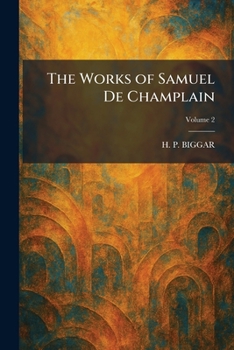
The Works of Samuel De Champlain

"The Works of Samuel De Champlain", Volume 2, provides a detailed primary-source account of the foundational years of New France. Written by the explorer often remembered as the "Father of New France," this volume focuses on the pivotal period between 1608 and 1613. The narrative captures the historic establishment of the settlement at Quebec, an event that marked a turning point in the colonial history of North America.
The text delivers profound insights into Champlain's navigations of the St. Lawrence River and his travels into the interior of the continent. It documents his significant encounters and alliances with Indigenous nations, including the Huron and Algonquin, as well as the initial conflicts that would shape regional politics for decades. Champlain's meticulous observations extend beyond mere travelogue, offering early ethnographic details and cartographic descriptions of a landscape that was largely unknown to Europeans at the time.
This scholarly edition preserves the observations of one of history's most influential cartographers and explorers. It serves as an indispensable resource for those interested in the challenges of early colonial life, the complexities of early cultural exchanges, and the rigorous spirit of 17th-century discovery. This work remains a cornerstone of Canadian historical literature, providing an authentic window into the birth of a nation.
This work has been selected by scholars as being culturally important, and is part of the knowledge base of civilization as we know it. This work was reproduced from the original artifact, and remains as true to the original work as possible. Therefore, you may see the original copyright references, library stamps (as most of these works have been housed in our most important libraries around the world), and other notations in the work.
This work is in the public domain in the United States of America, and possibly other nations. Within the United States, you may freely copy and distribute this work, as no entity (individual or corporate) has a copyright on the body of the work.
As a reproduction of a historical artifact, this work may contain missing or blurred pages, poor pictures, errant marks, etc. Scholars believe, and we concur, that this work is important enough to be preserved, reproduced, and made generally available to the public. We appreciate your support of the preservation process, and thank you for being an important part of keeping this knowledge alive and relevant.
Customer Reviews
ThriftBooks ® and the ThriftBooks ® logo are registered trademarks of Thrift Books Global, LLC
