


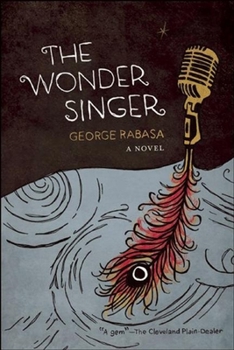
The Wonder Singer


Select Format
Select Condition 
Book Overview
The Wonder Singer is an operatic literary caper about one young writer's manic ambition. The ghostwriter's best chance at fame almost disappears when his Diva dies suddenly in her bath. His solution... This description may be from another edition of this product.
Format:Paperback
Language:English
ISBN:1932961690
ISBN13:9781932961690
Release Date:September 2009
Publisher:Unbridled Books
Length:336 Pages
Weight:1.00 lbs.
Dimensions:0.9" x 6.1" x 8.9"
Related Subjects
Action & Adventure Biographical Contemporary Fiction Genre Fiction Literary Literature & FictionCustomer Reviews
5 ratings
Characters Drive This Fabulous Story
Published by Thriftbooks.com User , 17 years ago
According to writer Mark Lockwood, there's no shame in being called a hack, a hired gun. They get the job done, he says. But his ability to churn out product is not what drives world-renowned opera singer Merce Casals to choose him as the ghostwriter of her memoirs. "He listens," she explains simply. And in George Rabasa's The Wonder Singer, Lockwood does listen, intently at first, to the diva weave her tale. But when his elderly muse dies suddenly, Lockwood becomes obsessed with listening to their recorded interviews night and day in an effort to finish her memoirs and do justice to her life story. Lockwood is not the only one vying to tell the diva's story, though. A top publishing agent and a famous author are on Lockwood's tail, aiming to retrieve the tapes and notes. This literary tug-of-war provides for some comical scenes as the writers try to outdo each other in digging for answers and mining Casals' contacts and relations (in one scene, Lockwood's rival even plucks some hair from the singer while she lies at rest in her coffin...later he submits it for DNA analysis, hoping it will offer an interesting twist to his manuscript). Joining Lockwood in his race to finish the book are Casals' former nurse, Perla, and a scarily-accurate Casals imitator named Orson. Casals husband, Nolan - placed in an assisted care facility by Merce years ago - even joins in on the caper. Not everyone is willing to play Lockwood's game, though. His wife, Claire, grows impatient with his obsession and his resulting distance from her (made only wider by Lockwood's foolish flirtations with Perla). My favorite part of The Wonder Singer was how well the author brought his characters to life. I could hear them, I could see them, I believed them. That doesn't mean I always liked them, which is even more impressive that the author made me care. I didn't like that none of the married characters seemed capable of being 100% loyal to their spouses. I was annoyed at how Lockwood became increasingly pathetic in his obsession with writing Casals' story. Perla seemed like a tease and a mooch. Orson was just...well...there for the ride, I guess. Nolan was hornery, though charming. And Casals herself could certainly behave like the diva everyone assumed she was. BUT...I still cared about each of them. I enjoyed them through all their flaws and foibles. I also think author Rabasa did a fantastic job knitting Casals memoirs - the story within the story here, the real "Wonder Singer" - into Lockwood's adventure. The sincerity of her life history helped to balance the off-kilter endeavors of Lockwood to bring her story to the people. The Wonder Singer was unlike anything I had read recently, and I really enjoyed the trip. Thank you, thank you to Caitlin at Unbridled Books for this review copy!
"It's about you. It sounds like you, I am speaking your voice"
Published by Thriftbooks.com User , 17 years ago
In the Wonder Singer the contemporary and the historical merge to produce a tale of two struggling artists - a writer and an opera singer, both born in different times and places, but who both share a common capacity for love and for passion. Mark Lockwood, in his "rumpled khakis and pocket t-shirt," decides that he will pursue the biography of grand dame Merce Casals even after the eighty-year-old dies in her favorite bathroom. A legendary singer that had a deep sense of her place in history, Merce has led a colorful life plagued by near misses and blown opportunities, where even when an unhappy end seemed near and inevitable, great fame and fortune was ultimately achieved. With her tomato-red hair, all the time sitting smug and queenly staring at her ghostwriter with a mix of suspicion and amusement, Merce fanatically dictates to Lockwood her story, aiming to "flush the rats from her past." An artist, but also an insufferable egoist, for Merce, singing was a almost spiritual act. But as Merce's words flutter around Mark, he begins to listen to her voice from deep inside him, her life becoming his life. It's as though she had died before her time, and left it up to him to deal with her unresolved business, especially that of her "small guilts and her fierce grudges." It is at the singer's apartment that Mark meets Perla, Merce's maid, who after 18 months of service to the Senora has finally had her charge lifted off her hands. The attraction to Perla is instant, her charming ways providing a stark antithesis to life with his wife Claire who admits that she liked him better before he became obsessed with his muse. Claire is even suspicious that her husband has actually fallen in love, not just with Merce, but also with Perla. Its as though he's in the presence of a dark angel angling for nurse duty in the afterlife: "To have both the Senora's story and the girl is the height of good fortune." Lockwood is in danger of being exploited, even sidelined by his own agent who has begun to push him off the project, smuggling in a famous writer under an alias, and stopping at nothing to get to Merce's precious tapes and memorabilia, the ultimate keys to her fractured life. It is through these tapes that Merce's tumultuous life is revealed, along with her carefully hidden secrets, the memories that keep her tethered to earth for ever. Growing up in Spain, she was abandoned by her father after a card game then adopted by the shady impresario Pep Saval in a humble inn in an out of the way village; and then thrust into the terrible violence in Barcelona, the acts of atrocity committed and the realization that she's not about to let war ruin her life; and then her great love, her husband Nolan Keefe with his letters full of vague hopes and the reckless promise to send her steamer passage so she can join him in New York. Mark's own struggles as a writer, his failing marriage and his growing obsession with Perla are interlocked with Merce's colorful life
A life lived large inspires the same
Published by Thriftbooks.com User , 17 years ago
The Wonder Singer by George Rabasa is the mesmerizing tale of a writer who becomes so obsessed with the object of the biography he's ghostwriting, he loses his wife and his sanity. Mark Lockwood has been hired to write the biography of famed opera soprano Merce Casals. This is a step up from the nihilistic series How to Talk to Your Teen he's been writing, as well as freelancing brochures and ads for anyone who comes up with the cash. Mark sits with the diva for six hours a day recording the stories of her life and immersing himself in her memories, until the day Merce's nurse, Perla, finds her dead in the bathtub. Now the demand for Casal's story has skyrocketed, and a high profile Hollywood writer has been hired to write it. Mark's tapes are of value; Mark himself is not. So Mark absconds with the tapes and hides out with Perla and a Merce fan named Oscar who dresses in drag and lipsynchs to the diva's recordings. Throw in Merce's husband Nolan who was banished from her life to a retirement home, and the story is quirky in all the right ways. The story flips between the tale of Mark's quest for this story and his actual telling of Merce's life. Rabasa has a talent for writing beautifully, poignant passages: In the end the voice does what it wants. It's never hungry or thirsty, hot or cold, never sad or angry, guilty or innocent. It doesn't shop or gossip or tingle to another's touch. It just is what is wants to be. In the end of Merce's long and eventful life, she sought only to be happy within herself, and that is the lesson that she imparts to Mark and the reader as well. Lyrical and funny, this is the perfect book for a rainy, fall day.
A wonderful read and one worth your time
Published by Thriftbooks.com User , 17 years ago
Eccentrics are created by environment and education, very similar to the formation of an Intelligence Quotient. George Rabasa's The Wonder Singer is an exploration of the life in the development of a diva. The glimpse into her discovery, training, and childhood as told by her to the 'scribbler' Mark Lockwood is an in depth analysis of how people get to be who they are. As a retired artiste, the diva, now in her later years, listens to her operatic recordings and reminisces on how life used to be as she tells her story to a tape recorder. Sadly, she tells of being abandoned by her father, after he lost her in a poker game! Fortune had come her way and the peacock which graces the cover the book had been one of two which she had kept as pets. Merce Casals is recorded by Lockwood on hundreds of cassettes as they met daily to develop an autobiography intended to tell the world about her 80 plus years of accomplishments as an opera star. Then, as they come near the finale of her story, she dies in her bath! A mad scramble ensues as Perla the nurse and Mark the 'scribbler' evade a renowned celebrity biographer so they can bring their own book to the public based upon the tapes, first. While this madcap adventure unfolds, enters Nolan Keefe, the diva's husband, who Mark and Perla take under their wings to rescue from a retirement home. Mix into this kettle a female impersonator, who professes to be the diva's greatest fan. Thus, evolves a novel which is fun, serious, and akin to a comic opera! A wonder of a book within a book; this saga of the writer and his subject tells the story through the eyes of the diva before she became famous. After her recognition as a truly great star, she tells of the many appearances and acclaim she has received throughout her career. Fame which fades and also that which is anticipated by the 'scribbler', are the elements which make this a wonderful read and one worth your time. The Wonder Singer is highly recommended and is another accomplishment of George Rabasa who wrote award winning Floating Kingdom and The Cleansing. Clark Isaacs Reviewer
I have mixed feelings, but worth the read
Published by Thriftbooks.com User , 17 years ago
Forty-year-old Mark Lockwood has been commissioned to ghostwrite the autobiography of Senora Mercè Casals, diva. For six hours a day he and the Senora, once the world's greatest soprano, talk--she reliving her roles as Norma and Aida and Violetta. She relives the rest of her life as well, singing on her father's cue in bars and hostels, the stranger her father handed her off to, the Spanish Civil War, the men in her life who claimed her and used her and loved her. But after 500 hours of conversation recorded on the precarious snakes of tape spooled in a suitcase's worth of cassettes, Lockwood's diva up and dies, her 80-something body floating "pale, blubberous and opalescent in her bath." The fate of Lockwood's book, given her death, is now up in the air. Lockwood was the right man for the job while the Senora was alive, but with her death his agent wants a bigger name, a bestselling author, someone who can churn out a doorstep-sized biography that will grace the supermarket aisles. He's ready to ditch Lockwood with a fat kill fee. But Lockwood has the tapes, without which the book project--like the diva herself--is pretty much dead in the water. Now obsessed with the diva and with his book, Lockwood grabs the tapes and runs. In The Wonder Singer Rabasa tells the intertwined stories of Lockwood and Senora Casals, his narrative slipping back and forth from what's going on in the narrative present to Lockwood's interviews with the dival to chapters taken from the manuscript he's writing. He's working feverishly, writing 8-12 hours a day and listening to the tapes even while he sleeps, ignoring phone calls and running from his agent's goons, destroying his marriage. But mostly Rabasa's story is about the diva, her life told in her voice in great detail so that she comes alive, a believable character. In parts Rabasa's book shines, but it goes on overlong and can drag. Some parts of the plot are hard to believe--the extent of Lockwood's obsession, for one; Casals' husband announcing his latest conquest by holding aloft her purple underwear in a crowded Mexican dance hall. More hard to believe is the dialogue, which is too perfect to be credible. Toward the end of the book Lockwood's wife draws attention to this very problem: "It's weird the way you start talking like a writer." "As opposed to talking like a plumber?" "You know what I mean. Like you don't really care whether anyone is listening or thinking that you're making sense, as long as the words resonate in your own head." She's respondong to a speech of his which reads in part: "You could look at the bottom of the pot and analyze the sediment of those ten thousand brewings and see our life divided into chapters. The Earl Gray phase and the era of the cheap Indian gunpowder and the year of green tea and the days of English Breakfast. Remember those green-tea times? We got up at five A.M. for Zen during seven months. I had a beard and you had a Buddhist-nun haircut. We were so earnest.
Copyright © 2026 Thriftbooks.com Terms of Use
| Privacy Policy | Do Not
Sell/Share My Personal Information | Cookie Policy | Cookie Preferences | Accessibility Statement
ThriftBooks® and the ThriftBooks® logo are registered trademarks of Thrift Books Global, LLC
ThriftBooks® and the ThriftBooks® logo are registered trademarks of Thrift Books Global, LLC
