


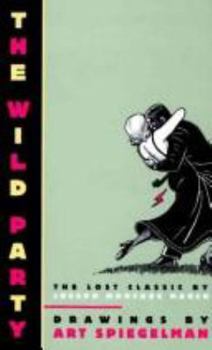
The Wild Party: The Lost Classic


Select Format
Select Condition 
Book Overview
Art Spiegelman's sinister and witty black-and-white drawings give charged new life to Joseph Moncure March's The Wild Party, a lost classic from 1928. The inventive and varied page designs offer... This description may be from another edition of this product.
Format:Hardcover
Language:English
ISBN:0679424504
ISBN13:9780679424505
Release Date:November 1994
Publisher:Pantheon
Length:110 Pages
Weight:0.85 lbs.
Dimensions:9.0" x 0.5" x 5.5"
Customer Reviews
5 ratings
Brilliant
Published by Thriftbooks.com User , 25 years ago
A brilliant piece of writing. I truly enjoyed this book.March has created a vivid world with a minimal amount of words and a very interesting style of poetry. I don't know that I've ever read an extended poem (for lack of a better word, it doesn't really qualify as an epic) that had me so involved and so interested in the story being told. The illustrations are amazing in this edition of the book as well. Highly recommended!
Outstanding Marriage of Style and Substance
Published by Thriftbooks.com User , 25 years ago
The menacing illustrations are good in and of themselves... the sometimes doggerlic, pulpy, but horribly compelling poem of fast living and decadence is good in and of itself... but when you encounter them together they produce a reading experience that transcends the sum of its parts. Brilliantly evokes a romanticized vision of the lost vice dens of the jazz age.
Chaotic and delicious
Published by Thriftbooks.com User , 25 years ago
Like many people, I picked up this book after seeing one of the two musicals in New York based on it last year (the LaChiusa one on Broadway, in my case). I thought both shows were highly enjoyable, and was pleased to learn that a good deal of their success could be attributed directly to the source material. March's poem (if it can indeed be called that) itself provides a brief but memorable glimpse into the darkest corners of a dangerous era.The story, such as it is, concerns the unhealthy relationship between two vaudeville performers, Queenie and Burrs, which comes to a head when they throw the party of the title. Among the guests are a number of people who have lived the high life for so long that they are no longer able to put their emotions in perspective -- they hurt each other and are hurt, but appear unable to learn from their mistakes. Naturally, the party ends with a mistake that is completely irrevocable and devastating.The piece would be compelling even without Art Spiegelman's perfect illustrations. With them, this is a book that shouldn't be missed.
wild and wonderful
Published by Thriftbooks.com User , 26 years ago
The wild party is a brilliant poem that pre-empts the beats' sense of rhythm and love for the low-down and dirty elements of modern life. Even though it was written six decades ago, it is fantastically modern. With a pulsuating, driving style that includes violence, humour and excitement, The Wild Party grips the reader from beginning to end. Spielgelman's illustrations, although nice and evocative, do not match the pure intensity of the writing. Well done to Spielgelman for finding this 'lost classic' and re-publishing it (although on the spine his name gets top billing which seem a little self-centred seeing as the books power lies entirely in the words, not the pictures. Indeed the writing is so bitingly vivid that the pictures are unneeded). I have read this book over a hundred times and it never fails to quicken my pulse and ressurect my love for poetry.
The party we all wish we could have been at
Published by Thriftbooks.com User , 28 years ago
This wonderful narration of one truly wild party sparks the imagination of unforgettable nights. It is written in a style that lends itself to being read aloud, as the dramatic content is high. Art Speigelman's illustrations make this night one book to remember, and add to the collection. This book will remind everyone of the night that they let their hair down and partied like the never had before, only to have to face the consequences.
Copyright © 2026 Thriftbooks.com
Terms of Use | Privacy Policy | Do Not Sell/Share My Personal Information | Cookie Policy | Cookie Preferences | Accessibility Statement
ThriftBooks ® and the ThriftBooks ® logo are registered trademarks of Thrift Books Global, LLC
ThriftBooks ® and the ThriftBooks ® logo are registered trademarks of Thrift Books Global, LLC
