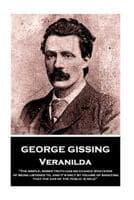
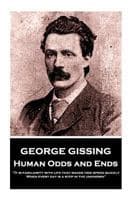
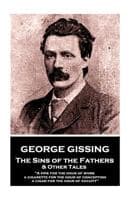
George Robert Gissing was born on November 22nd, 1857 in Wakefield, Yorkshire. He was educated at Back Lane School in Wakefield. Gissing loved school. He was enthusiastic with a thirst for learning and always diligent. By the age of ten he was reading Dickens, a lifelong hero.In 1872 Gissing won a scholarship to Owens College. Whilst there Gissing worked hard but remained solitary. Unfortunately, he had run short of funds and stole from his fellow students. He was arrested, prosecuted, found guilty, expelled and sentenced to a month's hard labour in 1876. On release he decided to start over. In September 1876 he travelled to the United States. Here he wrote short stories for the Chicago Tribune and other newspapers. On his return home he was ready for novels. Gissing self-published his first novel but it failed to sell. His second was acquired but never published. His writing career was static. Something had to change. And it did.By 1884 The Unclassed was published. Now everything he wrote was published. Both Isabel Clarendon and Demos appeared in 1886. He mined the lives of the working class as diligently as any capitalist.In 1889 Gissing used the proceeds from the sale of The Nether World to go to Italy. This trip formed the basis for his 1890 work The Emancipated.Gissing's works began to command higher payments. New Grub Street (1891) brought a fee of 250. Short stories followed and in 1895, three novellas were published; Eve's Ransom, The Paying Guest and Sleeping Fires. Gissing was careful to keep up with the changing attitudes of his audience. Unfortunately, he was also diagnosed as suffering from emphysema. The last years of his life were spent as a semi-invalid in France but he continued to write. 1899; The Crown of Life. Our Friend the Charlatan appeared in 1901, followed two years later by The Private Papers of Henry Ryecroft.George Robert Gissing died aged 46 on December 28th, 1903 after catching a chill on a winter walk. This description may be from another edition of this product.
This is a book that demands to be read - as do all of Gissings' books but "The Whirlpool" has been unjustly forgotten. When Gissing wrote "The Whirlpool" he was quite an expert on disfunctional families. The 1890s were the time of his greatest literary success but privately he was in the depths of despair. Harvey Rolfe (who was George Gissing's voice in the novel) marries Alma Frothingham. There are ominous signs before they are wed. Alma's philosophy is that she wants to live life free of duty and obligation (read selfish). Harvey doesn't see that - in his view she wants to be totally independant, he sees her as a "new woman". Alma is ultimately a tragic figure, whose love of praise and adulation is eventually her downfall. Gissing was interested in the "blood will out" view. Alma's father committed suicide but her mother is never mentioned. Harvey makes different remarks about Alma, maybe inheriting her unstable temperament from her mother but it is never gone into in detail. Gissing has some forward thinking ideas - a conversation with Mary Abbott, a widow who he helps financially when her husband commits suicide. She and Alma's stepmother, Mrs. Frothingham are two women, who by strength of character survive. Rolfe predicts there will come a day when there will be "establishments for young children of the middle class" - child care and kindergarten. The strongest relationship in the book is ulimately the one Harvey Rolfe enjoys with his little son Hugh - he is determined to bring him up and educate him in a new way, free of the restrictions of old.
1
★★★★☆
Vintage Gissing
By Thriftbooks.com User, June 19, 2007
Gissing has few equals in writing about relationships, especially relationships between men and women. Here he does particularly well in describing how a married couple, both with the best intentions, somehow, to the surprise and dismay of both, drift into suspicion and mistrust. Not my favorite Gissing because the story gets pretty melodramatic, but still, very good. And as always with Gissing, don't expect a happy ending.
1
★★★★★
Irresistible Character Analysis
By Thriftbooks.com User, May 29, 2005
Although this Gissing novel was revived for critical admiration about a century after it had first appeared to mixed or lackluster reviews, it continues to remain on murky, shadowy shelves, little-read. What a supreme shame. It is interesting from the beginning, never flagging in its incisive exploration of relationships. The novel is essentially a drawing-room drama that explores the autumn of the Victorian era. Its focus is on denizens who are not the bohemians or working-class outsiders to society that populated many of Gissings other books, but the lower and middle ranks of *society* itself. It follows the folks we would today call "trust-fund children," people poorly prepared for earning their own way in life, saddled with excess leisure time and burdened with a stringent set of rules about propriety. They, like their less fortunate fellow citizens, are having to learn as they go along about the modern era and its stock-market and social commodities. But this is only the backdrop for the meaty aspects of the book. The glory of the novel is Gissing's examination of relationships. By scrutinzing a particularly vivid woman-- a narcissist whose self-deceptions clamor to distort every attachment she forms-- the author brings an expert hand to describing marriages, friendships, parent-child bonds. Gissing shows a psychologist's keen insight into the ways that generations pass on strengths and weaknesses, the way a parent's behaviors will mold the desires of his children's adulthoods. He is perceptive about how vastly different people may attract one another in the subconscious hopes that they will counter-balance each other's excesses. He is able to show how friendships can round out-- or contaminate-- the weaknesses in a person's character. Impulses war with conscious goals in these people, loyalty is set against self-interest. The fickleness of adolescence, the intricacies of courtship, the successes and failures of marital negotiations-- all of these are brilliantly reflected in the plot. Gissing shows a masterly hand at dialogue. Domestic and societal intrigue are drawn into the story as the femme fatale becomes increasingly desperate. The novel is less overtly philosophical than his better-known *The Odd Women.* It is no less impressive, however. I enjoyed the book from beginning to end. The Everyman edition is especially fine-- it sports a great introduction by William Greenslade, timelines not only of Gissing's life but of the artistic and political era, as well as illuminating explanatory notes and excerpts from the reviews of the 1890s and 1980s.