


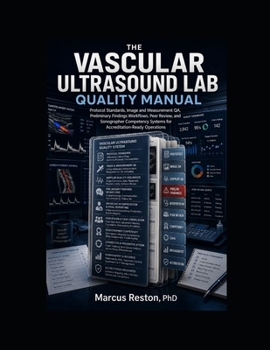
The Vascular Ultrasound Lab Quality Manual: Protocol Standards, Image and Measurement QA, Preliminary Findings Workflows, Peer Review, Sonographer Com

Turn Vascular Ultrasound Quality Into a System You Can Prove
A vascular ultrasound quality manual should do more than explain good practice. It should help your lab standardize the work, document the decisions, correct weak points, and present clear evidence when reviewers ask how your system operates.
When Good Work Is Trapped in People's Heads
Your team may scan well and still struggle with scattered protocols, copied forms, uneven image review, missing acknowledgment records, or last-minute accreditation preparation. You may worry that a manual will be too technical, become dated, or take months to put into use. Doing nothing leaves the same risks in place: different staff follow different habits, measurements vary, urgent findings travel through informal calls, and quality work produces little evidence.
A Working Operating System for the Vascular Lab
This vascular lab accreditation guide links governance, protocols, technical quality, reporting, peer review, competency, corrective action, and evidence control into one connected workflow. Each major process is paired with a stable A-series tool, a completed Meridian Vascular Laboratory example, and a blank master you can adapt. You see the finished document before building your own.
Thirty-Three Tools That Move From Policy to Proof
Start with a laboratory quality plan, source hierarchy, and role ownership.Build controlled vascular ultrasound protocols with versions, approvals, and staff acknowledgment.Score image quality against required-image matrices and assign specific coaching.Standardize Doppler angles, caliper placement, waveform selection, labeling, and rounding.Reconcile preliminary technical findings with final reports through closed-loop logs.Run peer review, competency checks, CAPA, dashboards, and mock accreditation review.Map every requirement to an owner, document, location, and evidence record.Built for the Problems Reviewers Actually Find
The manual addresses uncontrolled copies, silent protocol edits, undocumented limitations, scope errors, measurement variance, unclosed coaching loops, missing urgent-call records, stale credentials, and evidence that cannot be retrieved. The vascular ultrasound protocol manual keeps the sonographer's technical role separate from physician interpretation while showing how observations, escalation, and reconciliation should move through the lab.
Practical Enough for a Busy Department
You do not need to rebuild the whole system at once. Begin with the quality plan and document register. Add the image audit or urgent-findings workflow next. Every tool has a defined owner, trigger, record, and closeout point, so implementation can proceed in controlled pieces. Source labels and verification reminders also make it clear which standards must be checked against current governing documents before adoption.
See Useful Progress in the First Work Session
Open the appendix, choose the process causing the most friction, and compare the blank master with the completed example. In one session, you can identify missing owners, expired review dates, weak handoff language, or gaps between your protocol and your audit form. That first pass gives your team a concrete correction list, not another binder to shelve.
Build the Quality System Your Lab Can Use and Defend
Use this vascular ultrasound quality manual to turn scattered practice into controlled workflows, measurable technical standards, documented improvement, and accreditation-ready evidence your team can retrieve when it matters. The result is a quality language that carries from the scanner and worksheet to the QI meeting, competency file, corrective-action record, and accreditation evidence index.
Customer Reviews
ThriftBooks ® and the ThriftBooks ® logo are registered trademarks of Thrift Books Global, LLC
