


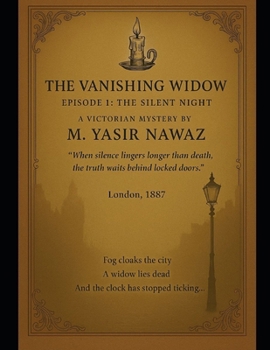
The Vanishing Window: The Silent Night
No Customer Reviews

Introduction
The Vanishing Widow: A Victorian Mystery
The Vanishing Widow by M. Yasir Nawaz is an atmospheric and intricately woven Victorian mystery that pulls readers into the fog-drenched streets of 1887 London, where the boundaries between life and death blur, and every whispered secret threatens to unravel the very fabric of reality. This haunting tale combines a chilling murder mystery with a supernatural edge, encapsulating the mystery genre's golden age while offering readers a fresh and original perspective on the genre's classics. The novel opens with the mysterious death of Lady Elizabeth Wilford, a wealthy widow living in the old district of Westminster, London. On a cold, silent November evening, a seemingly ordinary night turns grim when the body of Lady Wilford is found in her grand home, lifeless and untouched by any apparent violence. Her death is bizarre, with no signs of struggle or injury, but the strangest detail is that the clock in her sitting room had stopped exactly at midnight-the moment her life was snuffed out. This chilling discovery becomes the starting point of a journey through London's fog and shadow, as the police, led by the astute Inspector James Alden, attempt to uncover the secrets buried beneath Lady Wilford's tragic demise. What seems like a simple case of a widow's death quickly grows more complicated as Alden and his trusted sergeant, Edmund Cray, begin to investigate. As the investigation deepens, the story takes on an almost gothic atmosphere, with secrets being unearthed not only about Lady Wilford's life but also about the enigmatic history of her late husband, Sir Reginald Wilford. The couple's past is shrouded in mystery, but it soon becomes clear that Lady Wilford's death is entangled with the peculiar circumstances surrounding the tragic end of Lord William Harrow, a man who had been closely connected to the widow before his own untimely demise two years prior. Lady Wilford's death leads to a tangled web of betrayals, hidden relationships, and unspoken fears. As Alden begins to unravel the details, he finds that the case is more than just a murder. There is something darker at play, something that even he, with his years of experience in solving complex cases, cannot fully comprehend. The house itself, with its ancient walls and echoes of the past, seems to hold the answers, but it resists revealing its secrets, much like its inhabitants. The narrative gains layers of complexity as Alden uncovers the role of the family solicitor, Ambrose Duvall. Duvall's connection to the Wilford family and his ominous behavior raise red flags, suggesting that he may be hiding more than just legal documents. Alden and Cray's investigation into Duvall reveals unsettling details about the solicitor's past and his involvement with the strange and tragic events surrounding Lady Wilford and Lord Harrow. As Alden digs deeper, he uncovers the unsettling fact that the house itself might be cursed-a notion that had been whispered about by the servants and old residents for years but was dismissed as superstition. As the investigation progresses, the story takes a supernatural turn. Alden and Cray are confronted with eerie manifestations-shadowy figures, inexplicable noises, and strange phenomena that defy logic and reason. Lady Wilford's body, it seems, was just the beginning of a much darker tale, and the house appears to be the epicenter of a series of unnatural occurrences. Alden is soon confronted with the possibility that Lady Wilford's death may not have been a simple murder at all, but rather the culmination of an ancient ritual that has bound the house, its inhabitants, and the forces of life and death in an unholy connection.Format:Paperback
Language:English
ISBN:B0F53L7G5R
ISBN13:9798280057609
Release Date:April 2025
Publisher:Independently Published
Length:48 Pages
Weight:0.30 lbs.
Dimensions:0.1" x 8.5" x 11.0"
Customer Reviews
0 rating
Copyright © 2026 Thriftbooks.com
Terms of Use | Privacy Policy | Do Not Sell/Share My Personal Information | Cookie Notice | Cookie Preferences | Accessibility Statement
ThriftBooks ® and the ThriftBooks ® logo are registered trademarks of Thrift Books Global, LLC
ThriftBooks ® and the ThriftBooks ® logo are registered trademarks of Thrift Books Global, LLC
