


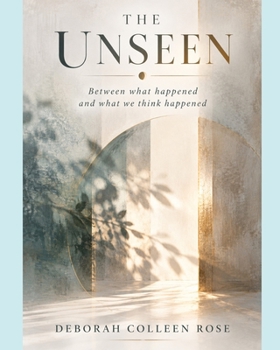
The Unseen: Between What Happened and What We Think Happened

Between what happened and what we think happened
A sound comes from an empty room.
A shadow seems to move.
You feel someone standing behind you, but when you turn around, no one is there.
Was it paranormal? Was there another explanation? And how do we really know the difference?
In The Unseen, Deborah Colleen Rose takes a thoughtful and honest look at the unexplained. Drawing from years of paranormal investigation, private investigative work, handwriting analysis, and the study of human behavior, she explores what happens when an experience doesn't fit neatly into what we already understand.
This is not a book about proving that ghosts exist.
It is not a book about proving they don't.
Instead, it asks us to slow down and investigate.
Rose explores how perception, memory, expectation, fear, environment, coincidence, and confirmation bias can shape what we experience. She explains how to approach an investigation, how to use paranormal equipment without giving it more meaning than it can support, and why an unusual reading is not automatically evidence of something supernatural.
But she also leaves room for the questions that remain.
Because sometimes an ordinary explanation doesn't answer everything.
Through personal experiences and lessons learned in the field, The Unseen explores the space between what we observe and what we believe happened. It considers the role of intuition, the limitations of human perception, and the importance of being willing to say, "I don't know."
For Rose, that uncertainty isn't a failure. It is where honest investigation begins.
Her Christian faith is also part of the conversation. She believes in God and in Christ and believes there is more to existence than what we can see. But she doesn't believe faith requires us to label every unexplained experience as supernatural. Faith and investigation can coexist. Curiosity and skepticism can coexist. Wonder and discernment can coexist.
Ultimately, The Unseen is an invitation to look more carefully.
To question assumptions.
To consider ordinary explanations before extraordinary ones.
To respect people's experiences without automatically accepting their conclusions.
And to remain open to the possibility that we may not understand everything yet.
Because the goal isn't to find a ghost.
The goal is to find the truth.
And sometimes the most honest answer isn't a conclusion.
It's a better question.
Customer Reviews
ThriftBooks ® and the ThriftBooks ® logo are registered trademarks of Thrift Books Global, LLC
