


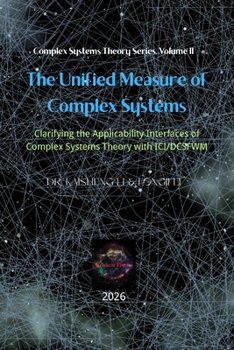
The Unified Measure of Complex Systems: Clarifying the Applicability Interfaces of Complex Systems Theory with ICI/DCSFWM
No Customer Reviews

This book develops a unifying framework for complex-systems theory by treating existing approaches not as rivals to be replaced, but as partial projections onto a common metric space. Its point of departure is a persistent problem in complexity science: network science, nonlinear dynamics, dissipative-structure theory, information theory, integrated information theory, and complex adaptive systems all capture genuine features of complexity, yet they do so in mutually incommensurable languages. A system may be complex in topology, unstable in dynamics, rich in information, costly in energy, or highly integrated, but without a shared coordinate system these claims cannot be compared, translated, or bounded.
The book proposes the Integrated Complexity Index (ICI) and its six-parameter DCSFWM structure as such a coordinate system. The six parameters are divided into two coupled groups. Diversity, scale, and reaction scale describe capacity: what kinds of components exist, how many carriers are involved, and how rapidly the system traverses states. Feedback, weighted frequency, and memory describe dynamic integration: whether the system closes causal loops, refreshes internal states, and calls upon history to shape future behavior. The resulting metric distinguishes mere magnitude from integrated organization. A large but non-integrated system can have a high baseline value without entering the same semantic domain as an autonomous, memory-bearing system.
The central methodological contribution is not a claim that ICI abolishes earlier theories. Rather, it uses ICI/DCSFWM as a public ruler. Each major tradition is mapped, located, delimited, and placed in complementarity with neighboring traditions. Network science illuminates topology but not, by itself, memory or dynamic refresh. Nonlinear dynamics captures temporal evolution, sensitivity, and bifurcation, but does not measure integrated historical dependence. Dissipative-structure theory explains order far from equilibrium, yet self-organization is not automatically autonomy. Information-theoretic and computational measures clarify uncertainty, description, and generation, but they must be separated from organized integration. The book's aim is to identify applicability interfaces rather than to declare any tradition obsolete.
A distinctive feature of the volume is its treatment of boundaries. Before a system can be measured, one must determine what counts as the system and where it ends. The book therefore develops an objective boundary logic: systems with FWM closure can be bounded by their functional feedback-memory domain, whereas systems without such closure must be bounded by aggregation or physical inclusion. This boundary theory is presented as logically prior to measurement, because diversity, scale, and reaction scale cannot be read unless the system has first been delimited.
Across the volume, the same discipline is maintained: unification must not become metaphor. Cross-domain mapping is admitted only under restricted universality, with distinctions among mechanism isomorphism, equation isomorphism, and parameter isomorphism. This constraint allows the book to compare cells, brains, technologies, economies, and non-autonomous physical systems without collapsing them into one undifferentiated notion of complexity. The result is an interface map of complex-systems theories: a way to see where each theory is strongest, where it becomes blind, and which neighboring theory should take over.
The book is both a theoretical proposal and a cartographic project. It proposes ICI/DCSFWM as a unified measure of integrated complexity, and it uses that measure to redraw the landscape of complexity science. Its contribution lies in making comparison possible without erasing difference: a common ruler, not a new empire.
The book proposes the Integrated Complexity Index (ICI) and its six-parameter DCSFWM structure as such a coordinate system. The six parameters are divided into two coupled groups. Diversity, scale, and reaction scale describe capacity: what kinds of components exist, how many carriers are involved, and how rapidly the system traverses states. Feedback, weighted frequency, and memory describe dynamic integration: whether the system closes causal loops, refreshes internal states, and calls upon history to shape future behavior. The resulting metric distinguishes mere magnitude from integrated organization. A large but non-integrated system can have a high baseline value without entering the same semantic domain as an autonomous, memory-bearing system.
The central methodological contribution is not a claim that ICI abolishes earlier theories. Rather, it uses ICI/DCSFWM as a public ruler. Each major tradition is mapped, located, delimited, and placed in complementarity with neighboring traditions. Network science illuminates topology but not, by itself, memory or dynamic refresh. Nonlinear dynamics captures temporal evolution, sensitivity, and bifurcation, but does not measure integrated historical dependence. Dissipative-structure theory explains order far from equilibrium, yet self-organization is not automatically autonomy. Information-theoretic and computational measures clarify uncertainty, description, and generation, but they must be separated from organized integration. The book's aim is to identify applicability interfaces rather than to declare any tradition obsolete.
A distinctive feature of the volume is its treatment of boundaries. Before a system can be measured, one must determine what counts as the system and where it ends. The book therefore develops an objective boundary logic: systems with FWM closure can be bounded by their functional feedback-memory domain, whereas systems without such closure must be bounded by aggregation or physical inclusion. This boundary theory is presented as logically prior to measurement, because diversity, scale, and reaction scale cannot be read unless the system has first been delimited.
Across the volume, the same discipline is maintained: unification must not become metaphor. Cross-domain mapping is admitted only under restricted universality, with distinctions among mechanism isomorphism, equation isomorphism, and parameter isomorphism. This constraint allows the book to compare cells, brains, technologies, economies, and non-autonomous physical systems without collapsing them into one undifferentiated notion of complexity. The result is an interface map of complex-systems theories: a way to see where each theory is strongest, where it becomes blind, and which neighboring theory should take over.
The book is both a theoretical proposal and a cartographic project. It proposes ICI/DCSFWM as a unified measure of integrated complexity, and it uses that measure to redraw the landscape of complexity science. Its contribution lies in making comparison possible without erasing difference: a common ruler, not a new empire.
Format:Paperback
Language:English
ISBN:B0H6VRHWY1
ISBN13:9798184778488
Release Date:June 2026
Publisher:Independently Published
Length:268 Pages
Weight:0.80 lbs.
Dimensions:0.6" x 6.0" x 9.0"
Customer Reviews
0 rating
Copyright © 2026 Thriftbooks.com
Terms of Use | Privacy Policy | Do Not Sell/Share My Personal Information | Cookie Policy | Cookie Preferences | Accessibility Statement
ThriftBooks ® and the ThriftBooks ® logo are registered trademarks of Thrift Books Global, LLC
ThriftBooks ® and the ThriftBooks ® logo are registered trademarks of Thrift Books Global, LLC
