


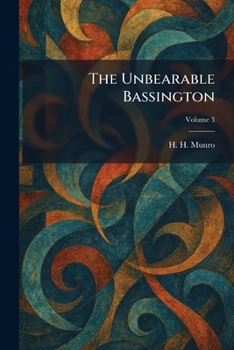
The Unbearable Bassington

"The Unbearable Bassington" is the first full-length novel by the master of the short story, Saki (H.H. Munro). Set against the backdrop of Edwardian London's high society, the work is a brilliant and biting satire that explores the complexities of social ambition and the fragility of status. The story centers on Francesca Bassington, a woman whose life is defined by her love for her art collection and her desire to maintain her social standing, and her son, Comus. Comus is a charming, witty, but utterly irresponsible young man who becomes the primary obstacle to his mother's carefully laid plans.
As Francesca attempts to engineer a wealthy marriage for her son to secure their financial future, the novel shifts from a sparkling comedy of manners into a poignant tragedy. Saki's signature wit is on full display, providing a sharp critique of the vanity and cruelty inherent in the upper-class social circles of the era. Renowned for its cynical humor and elegant prose, "The Unbearable Bassington" remains a profound exploration of the tensions between maternal love and material greed. This work stands as a testament to Munro's unique ability to blend devastating irony with a deep sense of pathos, making it a cornerstone of early 20th-century British literature.
This work has been selected by scholars as being culturally important, and is part of the knowledge base of civilization as we know it. This work was reproduced from the original artifact, and remains as true to the original work as possible. Therefore, you may see the original copyright references, library stamps (as most of these works have been housed in our most important libraries around the world), and other notations in the work.
This work is in the public domain in the United States of America, and possibly other nations. Within the United States, you may freely copy and distribute this work, as no entity (individual or corporate) has a copyright on the body of the work.
As a reproduction of a historical artifact, this work may contain missing or blurred pages, poor pictures, errant marks, etc. Scholars believe, and we concur, that this work is important enough to be preserved, reproduced, and made generally available to the public. We appreciate your support of the preservation process, and thank you for being an important part of keeping this knowledge alive and relevant.
Customer Reviews
ThriftBooks ® and the ThriftBooks ® logo are registered trademarks of Thrift Books Global, LLC
