


Trad of the New PB


Select Format
Select Condition 
Book Overview
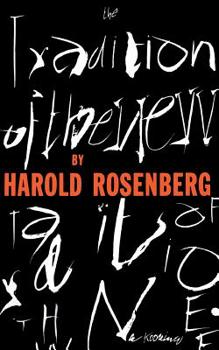
Harold Rosenberg was undoubtedly the most important American art critic of the twentieth century. It was he who first coined the term "Action Painters" to refer to the American Abstract Expressionists such as Pollock, Kline, and de Kooning. Rosenberg's seminal writings on this movement, as well as on other artists such as Newman and Rothko, appear in The Tradition of the New (1959), his first and most influential book; its effects on subsequent art criticism, and the practice of art itself, are still felt today. The essays in this book are not limited to the art world, however: He also discusses poetry, political and cultural theory, and popular culture. As wide-ranging, independent, and deeply probing as the essays of Walter Benjamin, Harold Rosenberg's The Tradition of the New is a true classic of twentieth-century criticism.
Format:Paperback
Language:English
ISBN:0306805960
ISBN13:9780306805967
Release Date:August 1994
Publisher:Grand Central Publishing
Length:285 Pages
Weight:0.80 lbs.
Dimensions:0.8" x 5.4" x 8.2"
Customer Reviews
2 ratings
excellent criticism
Published by Thriftbooks.com User , 19 years ago
I was surprised at how well these essays held up, and what a terrific writer Rosenberg was. Very witty as well, and not nearly as portentous as his better-remembered rival Clement Greenberg.
A book of advised reference!
Published by Thriftbooks.com User , 20 years ago
In the last Century, the art has ran vertiginously from vanguard in vanguard, in frank rupture not only with the tradition, but also with every movement immediately anterior. Rosenberg scrutinizes the different tendencies and besides, makes a itemized analysis about the form and expression around several issues; painting, literature, social behavior, conventionalisms, in a mesmerizing account of the most representative expressions and protagonists. A fundamental book, that, despite its years, maintains actual interest.
Copyright © 2026 Thriftbooks.com
Terms of Use | Privacy Policy | Do Not Sell/Share My Personal Information | Cookie Policy | Cookie Preferences | Accessibility Statement
ThriftBooks ® and the ThriftBooks ® logo are registered trademarks of Thrift Books Global, LLC
ThriftBooks ® and the ThriftBooks ® logo are registered trademarks of Thrift Books Global, LLC
