


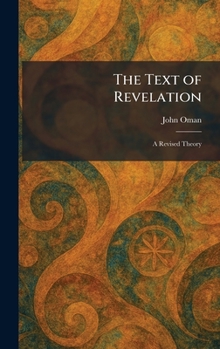
The Text of Revelation: A Revised Theory

"The Text of Revelation: A Revised Theory" by John Oman presents a profound and meticulous investigation into the structural and textual complexities of the final book of the New Testament. In this scholarly work, Oman challenges traditional interpretations by proposing a comprehensive theory regarding the original arrangement and composition of the Apocalypse. By examining the rhythmic structure and internal logic of the Greek text, Oman seeks to recover what he perceives as the authentic, coherent vision of the author, which he argues was obscured by later editorial rearrangements.
The book explores the intricate literary patterns within the "Book of Revelation", offering readers a fresh perspective on its prophetic and eschatological themes. Oman's approach combines rigorous textual criticism with a deep theological sensitivity, making it an essential resource for students of biblical studies and Johannine literature. By reconstructing the sequences of the text, this work provides a clearer understanding of the historical and spiritual context in which the visions were recorded. "The Text of Revelation: A Revised Theory" remains a significant contribution to biblical scholarship, reflecting the early twentieth-century quest to unlock the mysteries of one of the most challenging texts in the Christian canon.
This work has been selected by scholars as being culturally important, and is part of the knowledge base of civilization as we know it. This work was reproduced from the original artifact, and remains as true to the original work as possible. Therefore, you may see the original copyright references, library stamps (as most of these works have been housed in our most important libraries around the world), and other notations in the work.
This work is in the public domain in the United States of America, and possibly other nations. Within the United States, you may freely copy and distribute this work, as no entity (individual or corporate) has a copyright on the body of the work.
As a reproduction of a historical artifact, this work may contain missing or blurred pages, poor pictures, errant marks, etc. Scholars believe, and we concur, that this work is important enough to be preserved, reproduced, and made generally available to the public. We appreciate your support of the preservation process, and thank you for being an important part of keeping this knowledge alive and relevant.
Customer Reviews
ThriftBooks ® and the ThriftBooks ® logo are registered trademarks of Thrift Books Global, LLC
