


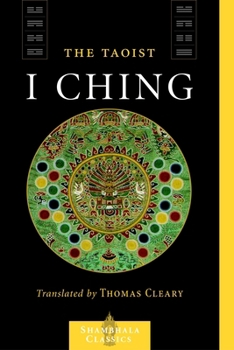
The Taoist I Ching


A fascinating two-part Taoist commentary on the classic Chinese text, the I Ching, from the 18th-century adept Liu I-ming The I Ching, or "Book of Change," is considered the oldest of the Chinese classics and has throughout history commanded unsurpassed prestige and popularity. Containing several layers of text and given numerous levels of interpretation, it has captured continuous attention for well over two thousand years. It has been considered a book of fundamental principles by philosophers, politicians, mystics, alchemists, yogis, diviners, sorcerers, and more recently by scientists and mathematicians. This first part of the present volume is the text of the I Ching proper--the sixty-four hexagrams, plus sayings on the hexagrams and their lines--with the commentary composed by Liu I-ming, a Taoist adept, in 1796. The second part is Liu I-ming's commentary on the two sections added to the I Ching by earlier commentators, believed to be members of the original Confucian school; these two sections are known as the Overall Images and the Mixed Hexagrams. In total, the book illuminates the Taoist inner teachings as practiced in the School of Complete Reality. Well versed in Buddhism and Confucianism as well as Taoism, Liu I-ming intended his work to be read as a guide to comprehensive self-realization while living an ordinary life in the world. In his attempt to lift the veil of mystery from the esoteric language of the I Ching , he employs the terminology of psychology, sociology, history, myth, and religion. This commentary on the I Ching stands as a major contribution to the elucidation of Chinese spiritual genius.
Format:Paperback
Language:English
ISBN:1590302605
ISBN13:9781590302606
Release Date:May 2005
Publisher:Shambhala Classics
Length:338 Pages
Weight:1.12 lbs.
Dimensions:0.9" x 6.0" x 9.1"
Customer Reviews
4 ratings
A great edition
Published by Thriftbooks.com User , 19 years ago
I have several editions of the i-Ching, but this is the one I would take to a desert island. This iteration of the text and commentary is relatively recent -- 18th century -- and very well developed. Each book in Cleary's i-Ching trilogy -- Buddhist, Taoist and the Tao of Organization -- offers something unique and appealing. The Taoist i-Ching is the most metaphysical of the three and the most developed. Although the Buddhist i-Ching is a bit more human and friendly, Taoist thinking tends to mesh better with the underlying concepts. The Taoist i-Ching is based on Complete Reality Taoism, which is very adaptible to beliefs from all walks of life. The processes of yin and yang rising and falling are most prominent in the commentaries. Overall, the edition reads as a very modern take on the ancient text.
Crossing life's rivers.
Published by Thriftbooks.com User , 24 years ago
"When people can see through everything, look deeply into themselves," the I CHING tells us, "and turn around to set their minds on essence and life, then in the midst of trance there will be a point of living potential that will subtly emerge." After reading his recent THE BUDDHIST I CHING, I revisited Thomas Cleary's earlier translation of THE TAOIST I CHING. The I CHING ("Book of Change") is the oldest of the Chinese classics, and is subject to many levels of interpretation. This reading was written in 1796 by Taoist Liu I-ming to reveal how the I CHING can be read as a guide "to self realization while living an ordinary life in the world." Although I do not profess to understand the I CHING--the "cryptic quality" of its sayings make it challenging reading--Cleary's translation is helpful in understanding this important text.The I CHING is beneficial in offering clear-minded, humble insights into crossing life's great rivers, mastering life's pitfalls, and finding one's path through life's inevitable changes with equanimity of mind. It teaches us "the way to be always correct is to become empty and keep quiet, to refine the mind." For anyone interested in embracing the Tao--travelling the path of personal transformation "with adorned feet"--this translation should not be missed.G. Merritt
A fine tool for the art of inner alchemy.
Published by Thriftbooks.com User , 26 years ago
This poetic, enigmatic rendering has the capacity to illuminate the difference between the human mind and the mind of Tao for the reader in situations of daily life, and offers profound Taoist methods for self awareness. I have used this book for five years and feel more than any other, this book has altered my life. For any who wish to use the Book of Changes as a guide for living with the aid of the wisdom of the Tao, I reccomend this translation of the I Ching.
Application of energetics to your daiIy I-Ching hexagrams
Published by Thriftbooks.com User , 27 years ago
The Taoist I Ching, translated by Thomas Cleary, was written by Liu I-Ming in the eighteenth century. It is an application of Taoist energetics to the 64 hexagrams and 384 lines of the I Ching. When used as a tool for self-cultivation, this work can aid the practitioner in an immediate understanding of the requirements that given energy formations place on one's daily life.If you are a serious student of the I Ching, seeking insight into the subtle operation of yin and yang, this text can aid in your search for understanding by illuminating a pathway through a given situation to balance and harmony. It is less of a divination oracle than many I Ching texts, but is one of the most applicable to engaged daily cultivation. The Taoist I Ching may seem a little wierd to use at first (it's definately different!) but has proven to be wholly rewarding in my life. Use it in conjunction with another translation - look for the commonality between the two - and gain the understanding that Master Liu encrypted within the pages. Ancestor Lu, the immortal Lu T'ung Pin, wrote of the I Ching in the ninth century " The shallow may take the I Ching to be a book of divination, but the profound consider it the secret of the celestial mechanism." Liu I-Ming's "Taoist I Ching" is most certainly a rendering of Ancestor Lu's vision. Thomas Cleary's gifted translation of this work must certainly echo his virtue all the way to the Subtle Origin.
Copyright © 2026 Thriftbooks.com
Terms of Use | Privacy Policy | Do Not Sell/Share My Personal Information | Cookie Policy | Cookie Preferences | Accessibility Statement
ThriftBooks ® and the ThriftBooks ® logo are registered trademarks of Thrift Books Global, LLC
ThriftBooks ® and the ThriftBooks ® logo are registered trademarks of Thrift Books Global, LLC
