


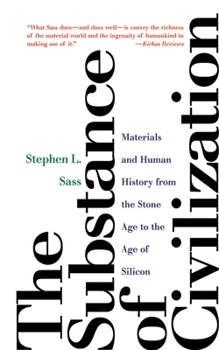
The Substance of Civilization: Materials and Human History from the Stone Age to the Age of Silicon


Select Format
Select Condition 
Book Overview
The story of human civilization can be read most deeply in the materials we have found or created, used or abused. They have dictated how we build, eat, communicate, wage war, create art, travel, and... This description may be from another edition of this product.
Format:Paperback
Language:English
ISBN:1611454018
ISBN13:9781611454017
Release Date:August 2011
Publisher:Skyhorse Publishing Company, Incorporated
Length:328 Pages
Weight:0.75 lbs.
Dimensions:1.2" x 5.5" x 8.1"
Customer Reviews
3 ratings
I love pop-science books, but this one misses the mark.
Published by bernie4444 , 26 days ago
I have a library of books on different items such as salt, paper, and other commodities, their origins, and trading history. So, I thought this book would make a great addition.
O.K., I confess I listened to the audio sample of the book to see if I wanted to buy it. The audio might not have done justice to the book, but it was enough to show that the author keeps missing the mark.
He mentions changing iron to steel. Then he mentions the Bessemer process, which is to the steel industry what the assembly line is to the auto industry; this is all well and good. Then he starts talking about railroad tracks. Early wood, iron, and steel tracks did have a problem, but it was not corrected because of the Bessemer process. The correction was to use Magnal, an alloy that gets stronger under stress. The same material safes are made with.
O.K. so he is trying to make a point without detail. However, this is misleading.
His next foray is into silicon, where he tries to equate industrial strength with pounds of sand. Oops, I mean the number of silicon chips, which have no meaning in themselves. I am sure he meant computing power or maybe cognitive capability. However, those are not materials, and the book is about materials in history.
O.K., so the author is trying to make a point. However, he chooses an irrelevant product or substance that is misleading.
Again, the audio might not do the rest of the book justice. However, if he can miss the mark twice in just the introduction, then how can we trust the balance?
A Great!
Published by Thriftbooks.com User , 20 years ago
I have read a vast quantity of books in my lifetime and believe that I have come across several great classics that fell through the cracks. This is one of them. There is hitch to this! It is parallel to the fate of The Jungle by Upton Sinclair. The Jungle was written to agitate social change and hit the literal stomach instead. The Substance of Civilization was written for light scientific interest and hit the survivalist instinct instead. I came across this book during the time of Y2K concerns. This is a pertinant survivalist handbook. It is how to start an economy from the literal dirt. I think this book draws the standard or baseline in answering, "How much science does an adult survivalist need to know?" Some people will find themselves short of science to meet this reasonable standard of scientific literacy. (I recommend the Beka science text books sold at Christian Liberty starting with the 4th grade. I think that is the one that teaches you how to measure the temperature through the use of a cricket. The 4th grade science book without meaning to unwinds those long descriptive garden walks in British 19th century novels. A reader is a little more clued in.)
History is an alloy....
Published by Thriftbooks.com User , 21 years ago
"History is an alloy of all the materials that we have invented or discovered,manipulated,used,and abused,and each has its tale to tell." These are the words of the author,a professor of material sciences at Cornell University.He is obviously in love with the subject he teaches.He reminds me of one of my Chemistry professors who was in the lab on a Saturday afternoon when a student happened to come by,and said;"Do you have to work on Saturday's?" He replied;"Son this isn't work,it's my hobby." Reading this book,one gets the feeling you are just having a friendly discussion with him about the subject that is his work,interest,fascination,and most of all what his love resolves around.Just the opposite of a Librarian I was having a social chat with one day.I asked what she liked to read;and the reply stunned me."I really don't like to read much;I get too much of it at work every day". Sass is a very good writer,particularly considering his profession.I don't say this as a slur;but generally good ,interesting writing is not the strong point of technical people.Carl Sagan is a great exception to this,and it shows Sass loves materials like Sagan loved the universe.Although I am an engineer,took courses in materials;I never heard them talked about like this. Sass shows how materials have influenced civilizations from the Stone Age to the present time and will continue to do so for the future.Not only that,but there will be materials invented at an astonishing rate,even more so than the last half century.Just imagine the things that have become commonplace in that time and how much their existance is dependent on space age materials.Dreams are the ideas behind inventions;but materials are what makes them happen. I read a lot of history,and particularly of warfare.I always believed that the one with the best weapon always wins the war.Now,after this excellent book,I have come to believe that the best weapon entails having the best materials to build them with.A great read.
Copyright © 2026 Thriftbooks.com
Terms of Use | Privacy Policy | Do Not Sell/Share My Personal Information | Cookie Policy | Cookie Preferences | Accessibility Statement
ThriftBooks ® and the ThriftBooks ® logo are registered trademarks of Thrift Books Global, LLC
ThriftBooks ® and the ThriftBooks ® logo are registered trademarks of Thrift Books Global, LLC
