


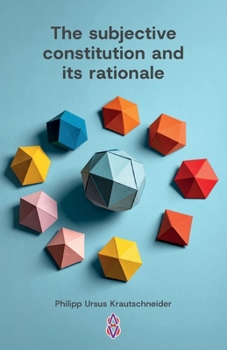
The subjective constitution and its rationale

The subjective constitution and its rationale
by Philipp Ursus Krautschneider
What if human behavior, morality, and even happiness could be understood from a single underlying principle?
In The subjective constitution and its rationale, Philipp Ursus Krautschneider presents a bold and original philosophical model that seeks to unify need, law, and consciousness. At its core lies a striking proposition:
"Someone else ought to feed me."
Far from being trivial, this statement is developed into a foundational norm-a structural fact about human existence. From this starting point, the author derives a complete inner "constitution" of the human subject, combining this basic norm with the logic of universal law.
The result is a compact yet profound framework that explains:
why we act-and why we must acthow moral reasoning emerges from dependencyhow freedom and obligation are intertwinedwhy human life unfolds between need and universal lawhow happiness can be understood as a dynamic equilibriumDrawing on and extending ideas reminiscent of Immanuel Kant's categorical imperative and modern legal theory, Krautschneider offers a new perspective: not metaphysics as the foundation of thought, but necessity-and the anticipation of its fulfillment.
This book is not a commentary on philosophy. It is an attempt to reset its starting point.
Concise, provocative, and conceptually rigorous, The subjective constitution and its rationale invites readers to rethink what it means to be human-and to recognize the hidden structure guiding every decision, every hope, and every action.
For readers interested in:
philosophy of mind, ethics, legal theory, human motivation, and foundational models of human behavior.
Customer Reviews
ThriftBooks ® and the ThriftBooks ® logo are registered trademarks of Thrift Books Global, LLC
