


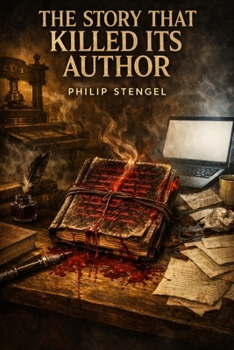
The Story That Killed Its Author

In 1888, printer and occult zealot Theron Croft uses blood, ritual parchment, and forbidden craft inside the rooms of The Eternal Press to create a manuscript that does not merely haunt its reader. It studies, seduces, and feeds. The author's life becomes its last sentence, and the story goes into the world hungry for the next hand foolish enough to open it.
More than a century later, failed novelist Adrian Locke is wrecked by public humiliation, creative paralysis, and the slow rot left behind by divorce. Then a brown-paper parcel appears at his apartment door. Inside is a hand-bound manuscript written in crimson ink that knows his failures, his habits, and the architecture of his private shame with impossible intimacy. Adrian should destroy it. Instead he reads. And the book begins arranging his life into narrative.
The first death proves the rule. The second proves the scope. Soon Adrian is dragged through murdered neighbors, fabricated identities, police scrutiny, vanished records, and a widening trail of people the manuscript can not only predict, but author. As the pattern widens, Claire, Finch, Graves, and the scattered survivors of earlier encounters force Adrian toward the truth behind the text: the thing writing him is not a cursed object in the ordinary sense. It is a predatory literary intelligence, a Prime Author that mistakes cruelty for art and human lives for structure. The Story That Killed Its Author is gothic metafictional horror about artistic vanity, narrative control, and the terror of realizing a story can decide you are more useful inside it than outside it.
Customer Reviews
ThriftBooks ® and the ThriftBooks ® logo are registered trademarks of Thrift Books Global, LLC
