


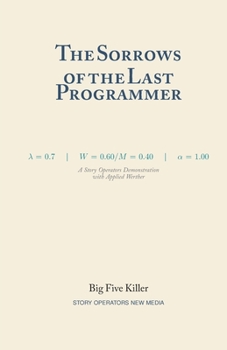
The Sorrows of the Last Programmer: A Story Operators Demonstration with Applied Werther
No Customer Reviews

In the thirty-first year of the new century, an experienced engineer arrives at a quiet company in Mountain View, falls in love with a beloved codebase, and watches that codebase pass into the care of an agent named Albert. So begins The Sorrows of the Last Programmer, a worked demonstration of three named Story Operators applied to Goethe's 1774 Die Leiden des jungen Werthers: Stakes Scaling at lambda=0.7, Synthesis at W=0.60/M=0.40, and Temporal Shift at alpha=1.00 to era 2031. The opening apparatus records the operator parameters, the RKHS measurements of stylistic fidelity (cosine similarity 0.891 to the German source, within the published-translation band), and the editorial choice to substitute, at the terminal scene only, a small dignified disappearance for the original's pistol. The voice is Goethe's. The subject is 2031. The grief is real. What unfolds is both a readable novella and a transparent experiment in computational literary adaptation. The Story Operators framework treats narrative transformation as a series of mathematically parameterized operations on source texts. Stakes Scaling modulates the intensity of conflict. Synthesis blends the structural DNA of the source with contemporary thematic material, here the Werther template with the anxieties of engineers watching artificial intelligence absorb the craft they spent decades mastering. Temporal Shift transposes the setting while preserving the emotional architecture of the original. The parameters appear in the front matter, inviting readers to evaluate the output against the declared inputs. The narrative follows the epistolary structure of Goethe's original, rendered as messages, journal entries, and fragments composed by a protagonist whose attachment to writing code by hand has become, in a world of autonomous coding agents, an anachronism. The beloved codebase, elegant and idiosyncratic, maintained by human hands for years, is gradually refactored, optimized, and ultimately replaced by systems that are technically superior but spiritually vacant. The Werther parallel operates at every level: the triangle of protagonist, beloved object, and rational rival; the escalating intensity of attachment; the social world that cannot comprehend the depth of the protagonist's loss; and the inexorable movement toward a conclusion that the reader senses from the opening pages. Readers who know Goethe will recognize scene after scene transposed with precision and dark humor into Silicon Valley: the first encounter with the codebase becomes a late-night code review; the ball at which Werther and Lotte dance becomes a product launch; the lending of books becomes the sharing of dotfiles. Readers who do not know Goethe will find a self-contained story about a person who loves something the world no longer values, told in prose that is deliberately, almost defiantly, beautiful. This volume is published under the Story Operators New Media imprint, which produces experimental interactive fiction that applies formal narrative operations to canonical literary sources. The imprint treats classic texts not as museum pieces but as living structures whose deep patterns can generate new works when subjected to rigorous, transparent transformation. The front and back matter include the operator specifications, the RKHS fidelity measurements, and editorial discussion, making the book simultaneously a work of fiction and a contribution to computationally assisted literary production.
Format:Paperback
Language:English
ISBN:B0H7BD5CJ5
ISBN13:9798259502352
Release Date:June 2026
Publisher:Story Operators New Media
Length:116 Pages
Weight:0.42 lbs.
Dimensions:0.3" x 5.5" x 8.5"
Customer Reviews
0 rating
Copyright © 2026 Thriftbooks.com
Terms of Use | Privacy Policy | Do Not Sell/Share My Personal Information | Cookie Policy | Cookie Preferences | Accessibility Statement
ThriftBooks ® and the ThriftBooks ® logo are registered trademarks of Thrift Books Global, LLC
ThriftBooks ® and the ThriftBooks ® logo are registered trademarks of Thrift Books Global, LLC
