


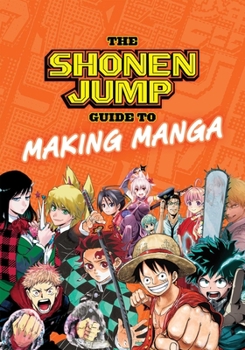
Shonen Jump Guide to Making Manga

Select Format
Select Condition 
Book Overview
The people who make the World's Most Popular Manga share their tricks, advice, and secrets! From Dragon Ball to Demon Slayer, from One Piece to My Hero Academia and beyond, Weekly Shonen Jump has published some of the finest manga to grace the earth. Now, the creators and editors behind several of the most popular manga in Shonen Jump sit down to discuss how to craft exciting stories, how to use your tools to the best of your abilities, and more. Whether you're getting started on your artistic path or a veteran looking for new tips, The Shonen Jump Guide to Making Manga is the perfect book to sharpen your skills. Featuring commentary and advice from Eiichiro Oda (One Piece), Tite Kubo (Bleach), Shun Saeki (Food Wars), Kaiu Shirai & Posuka Demizu (The Promised Neverland), Yusei Matsui (Assassination Classroom), Kohei Horikoshi (My Hero Academia), and more!
Format:Paperback
Language:English
ISBN:1974734145
ISBN13:9781974734146
Release Date:October 2022
Publisher:Viz Media
Length:178 Pages
Weight:0.66 lbs.
Dimensions:0.5" x 5.8" x 8.3"
Customer Reviews
1 rating
The best manga making guide out there!
Published by Hanii Aburame , 2 months ago
Summary:
This was a very down-to-earth guide that gave great examples and was engaging throughout. There is excellent advice within these pages for any type of creator, but obviously, especially for manga and comic artists.
Full review:
First off, this is a practical guide to making what you love, not a step-by-step how-to guide. This book gives you tips on how to make what you love in ways that work for you, and while this obviously does center on manga as it is from Shonen Jump/Viz Media, a bit of the advice could be used for other creators. Mainly for comics, yes, but some of the advice could work for writers and other artists too.
Particularly, chapter four: When stuck, return to your foundation. Sometimes tearing everything down - after saving everything, of course - and starting from square one again, maybe even from a different perspective, can really help the creative flow of any project. I loved how the prose in the book wasn't dry, lecture-esque, but a conversation between an SJ editor and an inspiring (fictional)maganaka. It didn't just hook me, but kept me engaged through the book, even when their conversations deepened into some technical stuff that normally would have zoned me out a time or two.
While visual aids are nothing new, especially in art books, I particularly liked how even the different sizes of draft paper, tools, etc., were shown. Actually seeing the different sizes of the paper specifically helped me to understand what they were talking about, instead of just having a vague idea, as I learn better by seeing. The multiple two-page manga stories from various artists in multiple genres with the same prompt were amazing to see and really showed how unique the same idea could be from different people.
More so with the big-name mangaka Q&A. Sadly, this was the only thing that did not hold my attention while reading the entirety of its chapter; all the posed questions were the same, and the answers were starting to blend together. However, I got around that by reading one or two of the interviews in between reading the following chapters. So, even though the questions were then familiar, it didn't feel as repetitive when read back-to-back, and I was able to absorb the professional's answers more effectively.
Copyright © 2026 Thriftbooks.com Terms of Use
| Privacy Policy | Do Not
Sell/Share My Personal Information | Cookie Policy | Cookie Preferences | Accessibility Statement
ThriftBooks® and the ThriftBooks® logo are registered trademarks of Thrift Books Global, LLC
ThriftBooks® and the ThriftBooks® logo are registered trademarks of Thrift Books Global, LLC
