


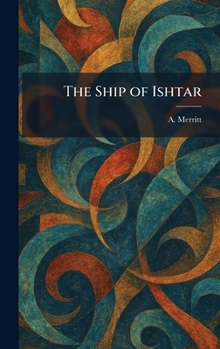
The Ship of Ishtar

"The Ship of Ishtar" is a landmark of early twentieth-century fantasy and pulp adventure. The narrative follows John Kenton, a veteran of the Great War, who receives a mysterious ancient block of alabaster. Upon breaking it open, he discovers a perfectly preserved model of a ship that serves as a portal to a supernatural dimension. Kenton is suddenly transported onto the deck of the real ship, a vessel eternally cursed to sail a timeless sea, divided between the forces of the goddess Ishtar and the dark god Nergal.
As Kenton navigates this strange world, he finds himself caught in a divine struggle between love and death, beauty and cruelty. To survive, he must forge alliances with a cast of colorful characters and master the laws of a reality where myth and magic are tangible forces. A. Merritt's lush, descriptive prose brings this fantastical voyage to life, blending elements of sword-and-sorcery with high-stakes mythological drama. "The Ship of Ishtar" remains a celebrated classic for its vivid world-building and its profound influence on the development of the modern fantasy genre. It is an essential read for those seeking a grand, imaginative journey into the unknown.
This work has been selected by scholars as being culturally important, and is part of the knowledge base of civilization as we know it. This work was reproduced from the original artifact, and remains as true to the original work as possible. Therefore, you may see the original copyright references, library stamps (as most of these works have been housed in our most important libraries around the world), and other notations in the work.
This work is in the public domain in the United States of America, and possibly other nations. Within the United States, you may freely copy and distribute this work, as no entity (individual or corporate) has a copyright on the body of the work.
As a reproduction of a historical artifact, this work may contain missing or blurred pages, poor pictures, errant marks, etc. Scholars believe, and we concur, that this work is important enough to be preserved, reproduced, and made generally available to the public. We appreciate your support of the preservation process, and thank you for being an important part of keeping this knowledge alive and relevant.
Customer Reviews
ThriftBooks ® and the ThriftBooks ® logo are registered trademarks of Thrift Books Global, LLC
