
Skip to content
Scan a barcode
Scan
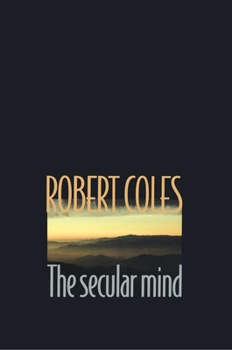
Paperback The Secular Mind Book

ISBN: 0691088624

ISBN13: 9780691088624

The Secular Mind

Select Format

Select Condition ThriftBooks Help Icon

Recommended

Format: Paperback

Condition: Very Good

$6.19
Save $48.81!
List Price $55.00
Almost Gone, Only 3 Left!
Save to List

Book Overview

Does the business of daily living distance us from life's mysteries? Do most Americans value spiritual thinking more as a hobby than as an all-encompassing approach to life? Will the concept of the soul be defunct after the next few generations? Child psychiatrist and best-selling author Robert Coles offers a profound meditation on how secular culture has settled into the hearts and minds of Americans. This book is a sweeping essay on the shift from religious control over Western society to the scientific dominance of the mind. Interwoven into the story is Coles's personal quest for understanding how the sense of the sacred has stood firm in the lives of individuals--both the famous and everyday people whom he has known--even as they have struggled with doubt.

As a student, Coles questioned Paul Tillich on the meaning of the "secular mind," and his fascination with the perceived opposition between secular and sacred intensified over the years. This book recounts conversations Coles has had with such figures as Anna Freud, Karen Horney, William Carlos Williams, Walker Percy, and Dorothy Day. Their words dramatize the frustration and the joy of living in both the secular and sacred realms. Coles masterfully draws on a variety of literary sources that trace the relationship of the sacred and the secular: the stories of Abraham and Moses, the writings of St. Paul, Augustine, Kierkegaard, Darwin, and Freud, and the fiction of George Eliot, Hardy, Meredith, Flannery O'Connor, and Huxley. Ever since biblical times, Coles shows us, the relationship between these two realms has thrived on conflict and accommodation.

Coles also notes that psychoanalysis was first viewed as a rival to religion in terms of getting a handle on inner truths. He provocatively demonstrates how psychoanalysis has either been incorporated into the thinking of many religious denominations or become a type of religion in itself. How will people in the next millennium deal with advances in chemistry and neurology? Will these sciences surpass psychoanalysis in controlling how we think and feel? This book is for anyone who has wondered about the fate of the soul and our ability to seek out the sacred in our constantly changing world.

Customer Reviews

1 rating

quirky insight into fundamental questions

I am a Robert Coles fan. I remember him as the most inspiring lecturer at Harvard with his quiet and sincere voice. That said I have found most of his writing a disappointment. Finally, with "The Secular Mind" Coles has written a book that is accessible; it may not be as stirring as his lectures (which might show just how important his actual voice is), but at least with this book the reader can get a sense of the quirky and exciting way Coles strives to address the most basic human questions.The reason this book succeeds more than his others is, I think, because it retains much of the spirit of his lectures. Coles takes a few simple questions: what is the difference between the religious life and the secular life? When, how and why has the secular way of thinking become more dominant in the last two hundred years? How do we deal with these changes given our shared desire for faith and purpose? Coles then consider how many thinkers he respects, including William Carlos Williams, Anna Freud, Dorthy Day, and Walker Percy, have responded to these questions. Part of what is unique about Coles is that he had the chutzpah to seek out and spend plenty of time with these thinkers. The result is a book that is intimate as well as profound. But this book is not without its faults. I don't understand why Coles insists on making his books so inaccessible. For one thing, this book lacks any kind of index. And then there are his sentences. He can't resist the parenthetical. At every turn there is a clause within a clause. This sentence about George Elliot is typical: "She was, of course, decades ahead of Freud, in her acknowledgement, that way, of the unconscious, its raw power constantly assertive, no matter our notion of ourselves as in (conscious) control of what we say or do." (p. 65) On balance, Coles is an interesting thinker, willing to raise the most profound personal questions about faith and purpose, and this book is a nice taste of his way of talking and thinking.
Copyright © 2026 Thriftbooks.com Terms of Use | Privacy Policy | Do Not Sell/Share My Personal Information | Cookie Policy | Cookie Preferences | Accessibility Statement
ThriftBooks® and the ThriftBooks® logo are registered trademarks of Thrift Books Global, LLC

GoDaddy Verified and Secured