


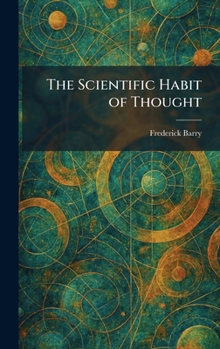
The Scientific Habit of Thought

"The Scientific Habit of Thought" is a profound exploration of the nature of scientific inquiry and its role as a fundamental framework for human reasoning. Frederick Barry provides a detailed analysis of the scientific method, moving beyond simple technical application to examine it as a comprehensive intellectual temperament. The work delves into the psychological and philosophical foundations that allow the scientific mind to distinguish between rigorous empirical evidence and common belief.
The text investigates the evolution of scientific thought and the essential principles of observation, verification, and logical deduction. Barry argues that the "scientific habit" is not merely for the specialist but is a vital tool for navigating the complexities of modern civilization. By fostering a worldview rooted in critical analysis and intellectual integrity, this discipline enables a deeper understanding of the physical world and the advancement of social progress. This treatise remains a significant contribution to the philosophy of science, offering readers a clear perspective on the methodology of discovery and the cognitive habits required for objective truth-seeking.
This work has been selected by scholars as being culturally important, and is part of the knowledge base of civilization as we know it. This work was reproduced from the original artifact, and remains as true to the original work as possible. Therefore, you may see the original copyright references, library stamps (as most of these works have been housed in our most important libraries around the world), and other notations in the work.
This work is in the public domain in the United States of America, and possibly other nations. Within the United States, you may freely copy and distribute this work, as no entity (individual or corporate) has a copyright on the body of the work.
As a reproduction of a historical artifact, this work may contain missing or blurred pages, poor pictures, errant marks, etc. Scholars believe, and we concur, that this work is important enough to be preserved, reproduced, and made generally available to the public. We appreciate your support of the preservation process, and thank you for being an important part of keeping this knowledge alive and relevant.
Customer Reviews
ThriftBooks ® and the ThriftBooks ® logo are registered trademarks of Thrift Books Global, LLC
