


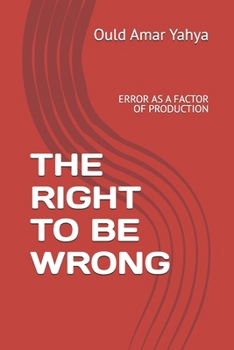
The Right to Be Wrong: Error as a Factor of Production

Reversibility, a Factor of Production
Why do nations rich in talent and resources remain poor - and why does capital change almost nothing there? Because economic science was missing a factor of production: reversibility - the fraction of any loss that a society knows how to recycle into a lesson and a fresh attempt, instead of letting it destroy the one who bears it. Between the glass nation and the spring nation lies a difference of manufacture - codes, courts, safety nets - and what can be manufactured can be measured, reformed, and governed.
From this single parameter, denoted ρ, the book derives a complete economics of underdevelopment: where error ruins beyond appeal, everyone rationally stops trying and the country freezes - capital flees the irrecoverable.
The great theories, from Ricardo to Keynes and Kahneman, turn out to have been written under a silent assumption - error can be repaired - and each receives its amended version. Crowning the edifice, a general theory of reversibility proves the conformity trap - no one tries because no one believes - to be a coordination failure with an exponentially growing escape time, and hands the reformer his operating manual: measure ρ, aim at the weakest link, jump cleanly, manufacture clemency events.
Capital said what nations possess, labor what they do; reversibility says what they forgive - and forgiveness, put into equations, turns out to be the most productive of the three.
Customer Reviews
ThriftBooks ® and the ThriftBooks ® logo are registered trademarks of Thrift Books Global, LLC
