


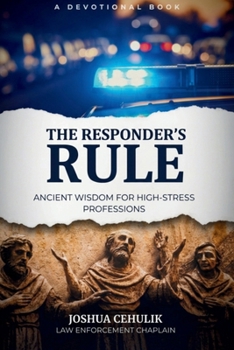
The Responder's Rule: Ancient Wisdom for High-Stress Professions

If you carry a badge, ride in a squad, answer 911, work a trauma bay, stand a post, or sit with people on the worst day of their lives, you already know the part of the job nobody trains you for: what to do with everything you saw after the shift is over.
THE RESPONDER'S RULE is thirty days of practical spiritual training for people who live close to suffering.
In the sixth century, Benedict of Nursia watched Rome unravel. Violence, displacement, and disorder were the daily backdrop of ordinary life. In the middle of that collapse, he wrote a short rule of life for common people who wanted to seek God together. His Rule is known for its moderation, its patience with human weakness, and its attention to the whole person: body, mind, and spirit. Fifteen centuries later, those same emphases show up in nearly every serious account of how people recover from traumatic stress and grow through it.
What's insideThirty daily entries, each following the same pattern:
A passage of ScriptureA short reflection connecting your world to an ancient practiceOne concrete practice, most taking fifteen minutes or lessA closing prayerThe thirty days fall into six movements of five days each: first safety and steadiness, then honest processing, then reconnection with God, with others, and with your own calling.
Days 1-5 Foundation: What Scripture actually says about trauma, lament, wounds that remain, and the whole person.Days 6-10 Stability: The discipline of staying. In rhythm, in community, for the long haul.Days 11-15 Sacred Reading: Lectio, meditatio, oratio, contemplatio. A different way to read the Bible.Days 16-20 Fixed Hours of Prayer: Reordering warped time with a morning watch, a midday anchor, and an end-of-watch liturgy.Days 21-25 Work Offered as Worship: Prayers from working hands, the dignity of small things, rest as obedience.Days 26-30 Hospitality: The road back to connection, and being sent.Designed for shift workersNothing here requires a quiet morning at a kitchen table. If your day starts at 1800 hours, your morning prayer starts at 1800 hours. Adapt freely.
No quick fixesBenedict distrusted spiritual shortcuts, and so does everyone who has walked with trauma survivors. What you will find is a steady thirty-day path through practices that ordinary people kept together through plague, war, exile, and ruin.
Who this book is forLaw enforcement, fire, EMS, dispatch, corrections, emergency and trauma medicine, military, chaplains, crisis and social workers, and the pastors, peer-support teams, and families who stand with them.
About the authorJoshua F. Cehulik serves as Associate and Worship Pastor at Calvary Baptist Church in Ashland, Ohio, and as a Law Enforcement Chaplain with the Ashland County Sheriff's Office. He also serves first responders through the Ohio Highway Patrol's Member Assistance Teams and the nonprofit OhioAssist, and sits on his local community mental health board. He is a PhD candidate in Christian Worship at Liberty University. This devotional grows out of his peer-reviewed research on Benedictine spiritual formation and post-traumatic growth, published in the Liberty Theological Review.
These pages offer spiritual practices intended to complement, never to replace, professional medical or mental health care. Readers experiencing symptoms of traumatic stress are encouraged to seek qualified help. In the United States, anyone in crisis can call or text 988.
Customer Reviews
ThriftBooks ® and the ThriftBooks ® logo are registered trademarks of Thrift Books Global, LLC
