


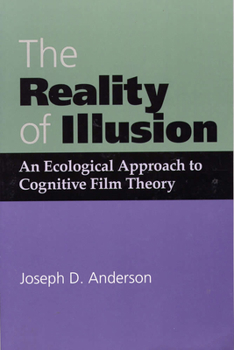
The Reality of Illusion: An Ecological Approach to Cognitive Film Theory


Select Format
Select Condition 
Book Overview
Applying research findings from studies in visual perception, neurophysiology, cognitive psychology, developmental psychology, and anthropology, Joseph D. Anderson defines the complex interaction of... This description may be from another edition of this product.
Format:Paperback
Language:English
ISBN:0809321963
ISBN13:9780809321964
Release Date:January 1998
Publisher:Southern Illinois University Press
Length:216 Pages
Weight:0.95 lbs.
Dimensions:0.6" x 5.9" x 8.1"
Customer Reviews
2 ratings
If you interested in the experience of watching a film....
Published by Thriftbooks.com User , 17 years ago
This is an excellent book if you are interested in the film experience. It is not a how to book on making films. Nor will it necessarily make you appreciate films more. But if you find it amazing that we enjoy films and if you wonder how film experience is different from everyday experience, then this is a very fine book. It stands in the classic tradition of attempts to figure out what is happening to the spectator when watching a film, such as Munsterberg's 1916 study relying on the psychology of his day and Rudolf Arnheim's work that relied on Gestalt psychology. Anderson's book relies on Gibsonian ecological psychology. It will show you what we know and make you amazed how mysterious the film experience is.
The book does what it says, and well
Published by Thriftbooks.com User , 18 years ago
For a psychologist and college teacher who uses films in class, plus is writing about films, education, and psychology, this book is a very good overview of how movies affect the viewer's mind and brain; that is basically the meaning of "cognitive theory." There are many other books written before and after, some going into great detail and using more sophisticated language from both film theory and cognitive science. However, the author's accessible style makes it a pleasure to work through and forms a foundation for further reading. It includes topics such as evolution, perception, emotion, neuroscience, and narrative in relation to how we perceive and respond to film. If my primary goal were to learn how to make films, of course cognitive theory would not be my first topic, but perhaps it makes sense to understand more of the thinking behind the creation. Surely learning a craft, even a very complex one such as film making, does not have to exclude a more thorough education.
Copyright © 2026 Thriftbooks.com
Terms of Use | Privacy Policy | Do Not Sell/Share My Personal Information | Cookie Notice | Cookie Preferences | Accessibility Statement
ThriftBooks ® and the ThriftBooks ® logo are registered trademarks of Thrift Books Global, LLC
ThriftBooks ® and the ThriftBooks ® logo are registered trademarks of Thrift Books Global, LLC
